A Le Pen presidency would introduce a new layer of risk to the French economy and the EU budget

Summary
- Marine Le Pen leads polls by a double-digit margin ahead of the spring 2027 presidential election. The main economic risks concern French public finances, the EU budget, and Ukraine funding.
- The National Rally estimates its pension reform would cost 18.6 BNEUR by 2032 and promises 140 BNEUR in savings by the end of Le Pen’s term. The author urges caution, as pension spending exceeds 430 BNEUR next year.
- Le Pen proposes cutting France’s EU contributions and ending its funding for Ukraine. France is the EU’s second-largest net contributor, while negotiations on the multiannual budget and Ukraine aid remain difficult.
- A Le Pen victory is uncertain, but the author says markets can no longer dismiss it as a risk. The yield spread on French government bonds over German bonds has already risen.
This content is generated by AI. You can give feedback on it in the Inderes forum.
Automatic translation: Originally published in Finnish 18/11/2026, 05:52 GMT. Give feedback here.
Marine Le Pen leads the polls for the spring 2027 presidential election by a double-digit margin. From an economic perspective, the greatest risks lie in France's public finances, the EU's multiannual budget, and funding for Ukraine.
Le Pen has made major promises in her election campaign. On Tuesday, according to Reuters, she reiterated that she would repeal President Macron's 2023 pension reform, which raised the retirement age from 62 to 64. Under the model proposed by the National Rally (RN), those who have worked for 40–42 years could retire at 60–62. The party now emphasizes years worked rather than the statutory retirement age. University graduates would therefore likely keep working well past 60. RN also proposes a EUR 900 billion fund alongside the pay-as-you-go system. It would be built up by channeling EUR 12 billion a year of employer contributions to Caisse des Dépôts, which manages pension and social security funds, among others, with a target return of 4–6% a year.
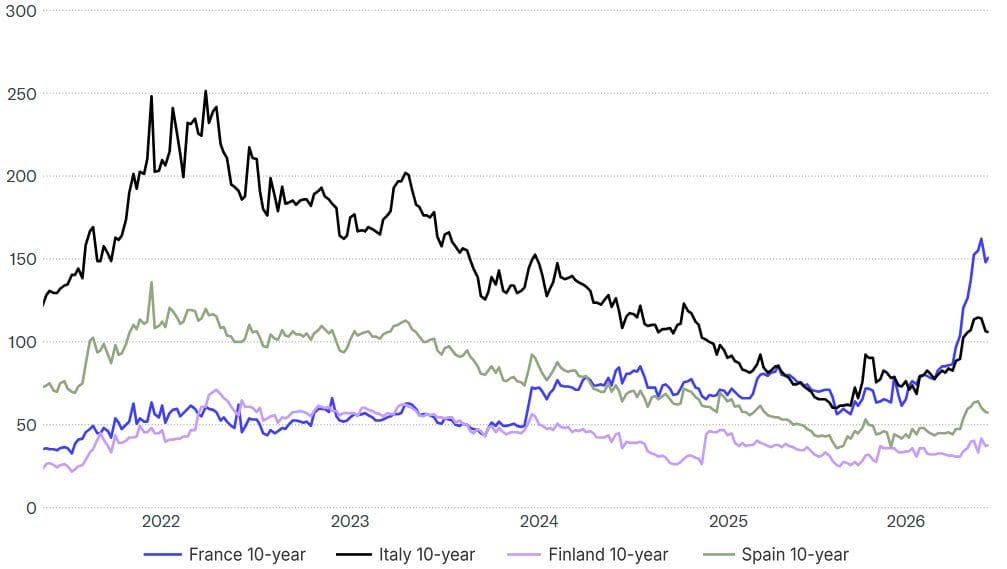
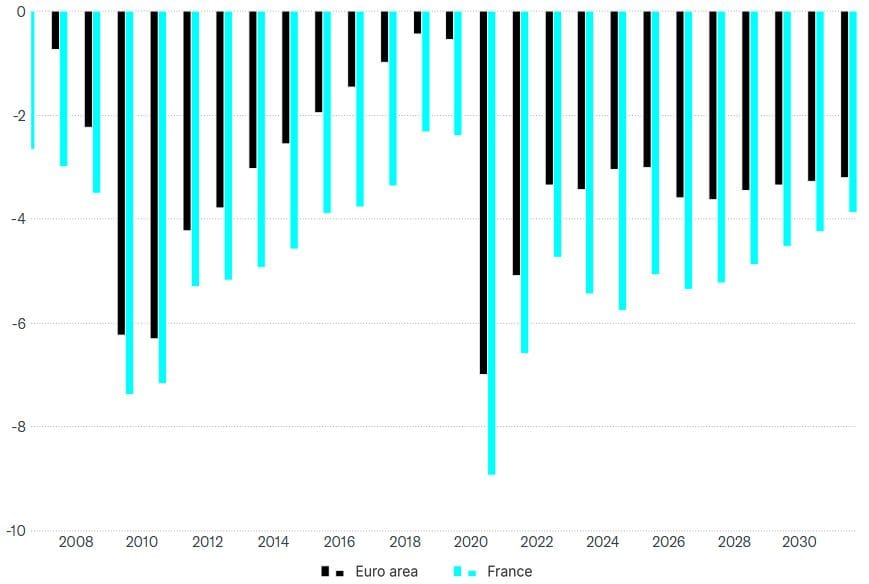
RN estimates the gross cost of the reform at EUR 18.6 billion by 2032. The party promises to cover most of it through savings and to halve the pension system deficit to EUR 4.8 billion. In total, Le Pen has promised EUR 140 billion in savings by the end of her term. However, these calculations should be treated with caution. Pensions are France's largest expenditure item – over EUR 430 billion next year – and curbing them is precisely where previous governments have stumbled. At the same time, the European Commission forecasts the French economy to grow by only 0.4% this year and 0.6% next year, the weakest figures in the eurozone. With weak growth and a heavy debt burden combined, the debt market's patience could run out quickly.
Spread to Germany, 10-year bond, basis points
Source: LSEG
General government deficit, % of GDP, incl. IMF estimate
Source: LSEG
EU budget and Ukraine under threat of veto
The second risk lies in Brussels. Le Pen wants to cut France's EU contributions significantly and has said that France would no longer fund Ukraine, as reported by the WSJ, among others. France is the EU's second-largest net contributor, so cuts would strain relations, particularly with Germany, the Netherlands, and Sweden. For Ukraine, the stakes are even higher, as Europe has become its main supporter in the war against Russia. An EU retreat from funding would therefore clearly weaken Ukraine's position.
By mid-January at the latest, the EU is trying to agree on a multiannual budget of around EUR 2 trillion (2028–2034) and EUR 70 billion in funding for Ukraine for 2027. However, negotiations are difficult. Net contributors are demanding deeper cuts, and Hungary and Slovakia are threatening to veto the funding for Ukraine. If no agreement is reached in time, a President Le Pen could sink the budget.
A Le Pen victory is by no means certain yet, but the markets can no longer dismiss it as a risk. First in the line of fire are French government bonds, where the yield spread to Germany has already been rising. More broadly, the EU budget dispute and the uncertainty surrounding funding for Ukraine would increase Europe's political risk from a Finnish perspective as well. It is therefore important to monitor closely whether a budget agreement is reached before the elections in the spring.
