Economist's musings: An ode to boredom

Summary
- The author links last week’s technology-led sell-off to elevated risk, noting that ~85% of AI ecosystem revenue is generated within the ecosystem and financing strains are increasing.
- Despite Friday’s sell-off, the Stoxx 600 remains up nearly 6%. Chemicals gained 22% year-to-date, while carmakers fell nearly 23%, amid mounting competition, particularly from China.
- The author says AI’s productivity benefits remain uncertain and argues that traditional sectors can offer diversification as investors move away from crowded technology trades.
This content is generated by AI. You can give feedback on it in the Inderes forum.
Automatic translation: Originally published in Finnish 23/11/2026, 13:16 GMT. Give feedback here.
Bad news sells, as we know, and we investors are herd animals. The events of late last week were another reminder of how boredom can quite often be a good thing.
Last week saw a tumble in the stock market. The cause was not hard to guess: technology stocks plummeted and the criteria for a correction were met. In hindsight, it would be easy to say that this was to be expected, as risk levels in the sector are also high. As I have commented in my macro reviews over the past month, the core question remains the return on investment. ~85% of AI ecosystem revenues are still generated within the ecosystem itself. On the financial side, vulnerabilities are accumulating: the prices of hyperscalers' credit default swaps rose to a record level in October, and the financing costs of data center builders have increased. Meanwhile, a Democratic midterm election victory could stall data center projects. The Fed, on the other hand, is already preparing for a December rate hike, which threatens heavily indebted companies. Risks are also growing in the bond market as Asian savings flow into AI stocks instead of government bonds, and price-sensitive hedge funds have replaced passive central bank buyers. Furthermore, with investor leverage at a record level and holdings concentrated in the same stocks, simultaneous selling amplifies the movements.
On the other side of the scale are high return expectations and low valuations, at least in some companies. From an economist's perspective, it is also important to look beyond the investments, where it is currently pitch black. The productivity benefits of AI – in other words, its impacts on the long-term outlook of the real economy – remain a major question mark to which no one has an answer. This is why many investors have shifted their capital back to "boring" stocks, meaning traditional sectors.
The wallflower's moment in the spotlight
Europe has been considered a sort of easily overlooked wallflower of the stock market, rarely mentioned in hype discussions. This is no surprise: the Old Continent's exposure to AI remains small, at only ~10% in the Stoxx 600 index. However, even a wallflower can shine if the queen of the party trips over her own high heels and has to leave. Even after Friday, the Stoxx 600 index is still up by nearly 6%, while many others saw months of gains wiped out in an instant.
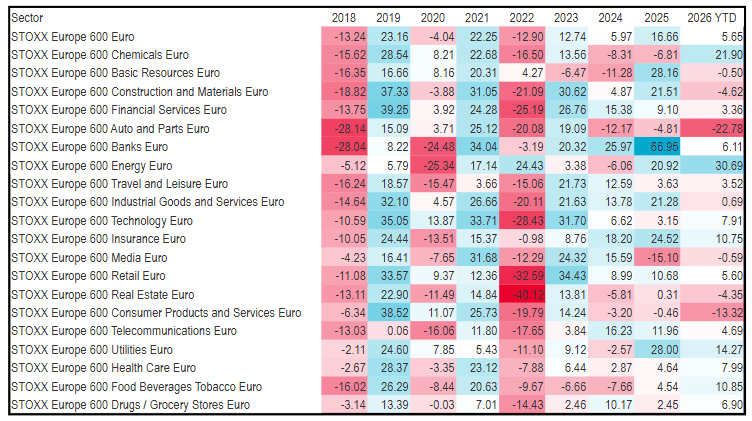
Stoxx 600 sectors, annual performance, %
Source: LSEG
What makes the European index even more interesting are its sectors. The chart below shows the annual returns of various sectors, with this year shown year-to-date. It comes as no surprise that the energy sector shines with its returns in Europe as well, but the top tier also features some unexpected names: for example, chemicals (+22% year-to-date), insurance (+11%), and food & beverage (+11%). Healthcare, known as a defensive sector, has also performed relatively well (+8%). Following the banking sector's stellar 2025, the rally has cooled, but the sector remains firmly in positive territory. The biggest loser is by no means the technology sector, but rather car manufacturers with a decline of nearly 23%. The threat there is not AI hype, but mounting competition, particularly from China. Thus, the story of the superficially boring European index is very different from that in the US, and winners can be found here too, even if they rarely make the headlines.
Child-rearing often emphasizes that boredom is a good thing because it encourages creative play. The same goes for an investor's life, as it can keep you away from the herd's foolish antics and inspire you to diversify.
