Remedy extensive report: Checkpoint reached, heading towards the next platform leap
- Recommendation
- Buy
- Target price
- 21.00 EUR
- Recommendation updated

Company description
Updated:
Remedy in brief
Remedy is an internationally renowned video game company that is known for story-driven and visually impressive console and computer games like Control, Alan Wake, and Max Payne. The company also develops its own Northlight game engine and game development tools.
A game studio known for story-driven action games
Remedy Entertainment (Remedy) is a Finnish video game developer founded in 1995. Remedy is best known for its story-driven and visually stunning action games, which the company develops for console and PC platforms. The company's best-known game brands include Control, Alan Wake, and Max Payne. The company owns all rights to Alan Wake and Control, and its growth strategy relies primarily on new games based on these brands. At the end of Q3’26, Remedy employed 378 people, most of whom are working in the company's Espoo studio. The company also has a studio in Stockholm.
Remedy's internal drive and ambition to develop unique, high-quality story-driven games and world-building are also reflected in the company's Metacritic scores. The company's average Metacritic score for story-driven single-player games (82/100) is strong. On Metacritic, games are given an overall rating by both critics and players separately. Games that receive over 90 points are critically acclaimed and rare. More than 80 points is already a very good achievement.
In 2017, Remedy began its transition to a multi-project model and value chain journey from subcontractor to independent game developer and publisher. Since then, much progress has been made, and the company now has the resources and capabilities to develop two projects simultaneously in full production. The company has also built the capabilities to act as a publisher for its self-published games. With self-publishing, the revenue and profit potential of games for Remedy is significantly higher than previous game projects.
| Metacritic score | |||
|---|---|---|---|
| Game | Release | Critics | Players |
| Death Rally | 1996 | - | 8,6 |
| Max Payne 1 | 2001 | 86 | 8,6 |
| Max Payne 2 | 2003 | 81 | 8,4 |
| Alan Wake | 2010 | 83 | 8,1 |
| AW's American Nightmare | 2012 | 75 | 7,3 |
| Quantum Break | 2016 | 72 | 6,1 |
| Control | 2019 | 84 | 7,5 |
| Control Ultimate edition | 2020 | 85 | 8,0 |
| Alan Wake Remastered | 2021 | 80 | 7,9 |
| Alan Wake 2 | 2023 | 89 | 8,4 |
| FBC: Firebreak | 2025 | 65 | 5,4 |
| Control Resonant | 2026 | 83 | 8,8 |
| Source: Metacritic, Inderes, Figures are platform averages | |||
Control, released in 2019, was the first major game to be published under a multi-project strategy and has proven to be a commercially successful product.
The next big release to rely on an own brand was Alan Wake 2, released in October 2023. The game was a critical success, but its commercial performance has turned out weak regardless. This was due to the game's budget having grown higher than the original plans and it not being available on the Steam platform.
FBC: Firebreak (2025) was Remedy's first self-published game and also the company's first multiplayer experiment. The game failed to gain momentum after the release, making it a commercial failure for Remedy. As a silver lining, the game's budget (around 30 MEUR) was also clearly smaller than the company's single-player projects.
Control Resonant, launched in September 2026, was Remedy's first self-published major single-player game. The game received good reviews (Metacritic 83), and players have received it even better than critics. The game sold over a million copies in around three weeks, making it the fastest-selling game in Remedy's history. The game is on track to become a commercially highly successful product, and we estimate that its cash flows will also enable the self-publishing of subsequent projects.
Regarding future game releases, the company has Max Payne 1&2 Remake in full production under the subcontracting model, which we expect to be released in early 2027. In addition, the company has an as-yet-unnamed game project in the production readiness phase, which we expect to be Alan Wake 3.
Business model
Updated:
Game development and publishing models
Big-budget video games
Remedy develops games for console and PC platforms. Today, games are mainly distributed through digital distribution platforms and, to a small extent, still via physical distributors. In game development, Remedy has two business areas: the development of its own game brands and the development of partner game brands using the subcontracting model. Today, Remedy's strategy focuses on self-publishing its own game brands, whereas historically, a publisher partner was typically involved. In self-published projects (FBC: Firebreak and Control 2), Remedy is fully responsible for the publishing, marketing, and distribution of the games. There may still be a partner to fund part of the project.
In a subcontracting model (Max Payne Remake), Remedy does not own the IP of the game being developed. In this case, the partner finances the game development and receives the majority of the revenue from game sales. Historically, in a proprietary IP model with a partner (Alan Wake 2), Remedy owns the game brand being developed, funds more development, and also gets a larger share of the game sales. However, the partner (Epic Games) has been responsible for publishing the game.
Games developed by Remedy are classified as AAA games, whose characteristics include a big production budget, high level of quality, and extensive marketing efforts. Large production values also mean that the games are aesthetically very pleasing, often utilizing the latest technology for effects and offering dozens of hours of gaming. The production budget for a typical Remedy AAA game has historically been an estimated ~30-60 MEUR. We currently estimate that the budgets for entirely new games are fundamentally >50 MEUR. For smaller spin-offs or shorter sequels, the budget could be smaller. As a rule of thumb, the marketing budget for AAA games is usually at least another 15-30% on top of the production budget, although for some major games, the figure is considerably higher.
Developing traditional AAA games is a high-risk business, with commercial success often requiring high sales volumes (millions of units). Game development cycles are typically 3-5 years. Often, a significant portion of a game's sales are concentrated in the launch period and the following year, with the majority of game sales occurring in the first three years. In the past, sales were much more front-loaded due to the important role of physical copies of games. Today, with digital distribution being mainstream, game sales are spread more evenly and over a longer period of time. High-quality games can sell well in digital channels for many years (e.g. Control) and can be supported by discount campaigns later on. Digital distribution is also a more profitable option for publishers and game developers as the material and logistics costs of physical copies are left out.
High-quality games are also in demand in video game subscription services (e.g. Xbox Game Pass and PlayStation Plus) and in the competition between digital marketplaces (Steam and Epic Games Store). Thus, deals made with these platforms have become a new important income source for game studios that can also be used to balance out the risks related to the number of game copies sold.
Game development lifecycle of Remedy games
Remedy's game development process for its own game brand, from the drawing board to the finished product, can be divided into five stages, and its targeted duration is around 2.5-4 years. A game project starts from the mandate phase, where high-level goals, a preliminary budget, and timeline are set for it. This phase typically involves only studio executives, the project's executive producer, and the core game team. The phase lasts 1 to 2 months. The conceptualization phase defines the game's vision, mechanics, themes, main characters, and visual identity. A preliminary prototype of the game is made at this phase. Typically less than 20 people are involved and the phase lasts 3-6 months.
During the proof-of-concept phase, a proper demo version of the game is made to test the game concept in practice. The team size is less than 50 people and the phase lasts about 4-12 months, depending on the game. At this point, a project plan is made about how the game will be developed (own staff and subcontracting), what components are needed. Furthermore, risks and major bottlenecks are identified. It is also important to prove that the game is fun and functional. The better the guidelines for the project are defined at this phase, the less surprises and delays are likely in the actual production phase. If a partner is brought in to finance the project, it often happens at this stage. The partner will then pay development fees in proportion to the number of people working on the project and its progress.
The next step in the production readiness phase is to assemble the project team for full production and finalize the production plan. This usually involves less than 75 people and lasts 3-6 months. In the production phase, the project is worked on by a full team, which at its most intensive stage can involve more than 200 people, including Remedy's team of more than 75 people and subcontractors. In the alpha phase of production, the previously drawn-up project plan is implemented, and the game is developed. Depending on the project, this phase lasts approximately 1 to 2 years. After that, in the beta phase, which lasts about 3 to 6 months, the game is fine-tuned to its final release form.
Following the game's release under the self-publishing model, all game sales revenue will be reflected in Remedy's income statement. Deducted from this are distribution costs paid to platforms, marketing costs, quality assurance, localization, and other publishing-related expenses. The revenue split payable to a potential partner is also visible on the cost lines.
The development of the game doesn't immediately stop at release, but a live team (often around 10-20 people) analyzes player behavior and publishes updates and bug fixes to improve the gaming experience. In addition, DLCs or other additional paid content may be developed for the games within around 1-2 years of the release to extend the game's life cycle.
Developing a game from own game brand
Game development is very scalable for the party carrying the financial risks. The biggest cost item for the developer is mostly fixed personnel costs, and profitability scales heavily with the sales of the game. Thus, self-funding makes the business very sensitive to rather unpredictable game sales. Historically, Remedy has shared this risk by including a publishing partner in its projects to finance part or most of the project. FBC: Firebreak was the first project for which the company assumed full financial and publishing responsibility. In Control Resonant, Annapurna is involved in funding 50% of the production budget. In terms of future projects, we estimate that Remedy will aim to finance the projects entirely by itself.
From the developer's point of view, developing your own game brands is an attractive option, as they allow for the development of add-ons and full sequels. Developing a sequel is easier, because you don't need to create a game world or characters from scratch. Moreover, demand predictability is better thanks to the pre-existing player base. Remedy can capitalize on this most scalable element of game development through its own game brands (Alan Wake and Control).
Illustration of the earnings impact of different publishing methods during the project's development and release phases
Game development as subcontracting
Developing games that are financed by a partner reduces the risk of failure and evens out the game developer’s cash flows through steady royalty income. However, it reduces the share of the revenue the developer receives, although subcontracting contracts typically include a royalty component linked to the sales of the game. Especially small game studios that lack the resources to finance development themselves develop games with the subcontracting model. Thus, the business model is broadly in line with customized software development, and scalability is poor.
Since its listing, Remedy has had an ongoing subcontracting project with a partner. Initially, the company worked for years on projects for Smilegate’s Crossfire games, and since 2022, the company has been working on a remake version of the Max Payne 1&2 games for Rockstar. Over the years, subcontracting has provided Remedy with steady cash flow, which has helped to offset the risks associated with its own game projects. At the same time, the aim has been to gain new lessons from subcontracting projects for its own game teams. The cooperation with Smilegate taught Remedy about the Asian market and FPS game development, while the collaboration with Rockstar strengthens Remedy's capabilities in action games.
Business models for Remedy games
Proprietary game engine brings that Remedy feel to the games
Remedy uses and develops its own game engine, Northlight, which provides economies of scale in a multi-project model and differentiates the company from competitors using commercial game engines. The game engine and the game development tools built around it are developed by the company's own team of more than 60 people.
With a competent and continuously developing technology team, the company can streamline the game development process by automating manual working stages. A strong technology team also provides the foundation for all development teams in the form of shared production and operating models. In-house technologies can also help streamline game development by allowing certain elements developed earlier to be reused in other projects.
Remedy's game engine made significant technological advancements during the development of Alan Wake 2, and the economies of scale it provides will be better leveraged in future game projects. A proprietary game engine can also allow Remedy to take advantage of the latest technologies faster than commercial engines and in a way that is tailored to the company’s needs.
External partners are also used in game development
Over the past five years, as the number of projects has grown, Remedy has increased the use of external development in game development. This enables, e.g., producing certain sound and graphics content through external partners. Furthermore, creating different game versions for various platforms can be outsourced.
External game development enables Remedy’s own personnel to focus increasingly on generating higher added value, i.e., planning the actual game worlds, characters, and stories, as well as developing game mechanics. It also allows for the development of more projects simultaneously and provides flexibility in the use of internal staff for different projects and also for recruitment needs.
Publishing capabilities of games have been gradually built up over the years
Over the years, Remedy has gradually expanded its own capabilities in the commercialization, marketing and publishing of games as its own brands have grown in importance. In previous projects published by the partner, Remedy was more actively involved in planning and contributing to the commercialization and marketing of the games, from which the company gradually learned lessons for self-publishing. As a result, the company's publishing operations (+marketing) now employ an estimated ~30 people. With Remedy now fully in charge of its own game brands, the company can be sure that every effort will be made to maximize the visibility and sales of the games.
Remedy has three guiding principles for how the company approaches self-publishing. Firstly, the company wants to keep its internal team focused and own the areas critical to publishing, while achieving global reach through selected key partners. Secondly, Remedy will only publish its self-published games, so there are no plans to expand publishing activities to publishing games made by others. Thirdly, Remedy wants publishing activities to be closely integrated with the development teams throughout the life cycle of the games.
Pricing and volumes of AAA games
Sales volumes is the most critical driver for the revenue of game brands owned by Remedy. Prices for AAA games are fairly standardized and are now around EUR 60-80 at launch. Over the long term, prices range from EUR 10 to EUR 50, depending on discount promotions. In other words, the price of low- and high-quality games is the same at the beginning, but it is harder to improve sales of a bad game with subsequent discount campaigns.
The rule of thumb in AAA game sales is the following volumes during the first years of the game: poorly selling game (1 million copies), reasonably selling game (2 million copies), very well selling game (5-10 million copies), and a hit game (>10 million copies). Thus, from the revenue viewpoint, the range for a single game varies from a few dozen million to as much as one billion.
Remedy’s competitive advantages stem from the ability to develop high-quality games through both efficient production and a high level of technology on a relatively low budget. In this way, the company's games are profitable with sales of just a few million copies. This also allows the company to develop games that are clearly differentiated from the mainstream for a specific target group, so that the company does not face such direct competition from the major game studios. However, the "weirdness" and variety of Remedy's games inevitably also discourage potential buyers.
Self-publishing increases potential
Remedy's goal for each game project is to achieve at least a 100% return on investment. For any project, this means first identifying the potential player base and then matching the game's development budget to that potential. Games that do well have the potential to return many times the capital invested in the project, and this optionality is one of the most attractive aspects of Remedy's business model. The company has stated that Control Resonant would need to sell approximately 3-4 million copies to reach the 100% ROI target (including potential revenue from B2B contracts).
Illustration of the profit potential of a game project with a publisher or self-published
The calculations above illustrate the profit potential of Remedy's publisher (100% funding and 50% revenue share) and self-published games. Mainly due to the fixed cost structure, the project's profitability will increase significantly as game sales increase from 100 MEUR to 200 MEUR. We believe that Remedy's future game projects have the potential to achieve this level of revenue, and that a hit game could do even more.
Game projects
Additional information
Source: Inderes
1 Inderes’ rough estimates of project production budgets and profit-sharing.
2 The production and marketing budget funded by the publisher must be covered in full or in part before royalties accrue to Remedy.
3 Remedy also funded Alan Wake 2 toward to some extent in the final satges of production to ensure the highest quality of the game.
4 Previous publishing agreement with 505 Games; starting in 2025, Remedy's share of net sales is 100%.
5 Remedy acts as the publisher of the game and is responsible for marketing costs, and thus receives a larger share of game sales. The game revenue will be split equally until the production budget is recouped.
Control (watch the trailer here)
Remedy's strategy is based on a multi-project model, with its first self-owned game brand, Control, launching in August 2019. Control is a third-person action-adventure with a clearly more open game world than in Remedy's previous, far more linear games. The length of the game experience was also longer at the time than the company's previous games.
Control had a production budget of around EUR 30 million, of which its publisher at the time, 505 Games, financed 55%. Remedy’s share of Control’s net sales was 45%, and from 2025 onwards it will 100%, as Remedy acquired all Control game brand rights from 505 Games in February 2024.
Control was very well received (Metascore 84/100) and the game won numerous critics' awards. However, Control's initial sales after release were moderate, and given the game's very good critical reception, it had the potential to do even better. However, the game continued to sell well in digital channels and was ultimately a commercial success too. With more than 6 million units sold, more than 20 million players and well over 100 MEUR in net sales, Control has already generated well over 100 MEUR.
FBC: Firebreak (watch the trailer here)
In June 2021, Remedy announced that it was developing a multiplayer project set in the world of Control (codenamed Condor). In October 2024, Remedy revealed that Condor was FBC. Firebreak, a three-player cooperative first-person shooter gam. The game had a development budget of around 30 MEUR, and it was Remedy's first self-published game project. The business model of the game was a mix of an AAA game and a service-based fixed-price game, where in addition to the base game (price EUR 40), additional paid content was available.
Remedy released the game on June 17, 2025, and its reviews from critics and players were poor right from the start. The game also failed to take off properly despite subsequent updates, and overall sales of the game remained very weak. As a result, Remedy was forced to issue a profit warning in October 2025 and record a write-down of 14.9 MEUR, which covered most of the game's capitalized development costs and acquired publishing and distribution rights allocated to it. Following the last major update made in early 2026, Remedy is no longer actively developing FBC: Firebreak. However, the game remains available on all platforms, as its maintenance costs are very minimal. We do not expect the game to generate significant revenue for Remedy.
Remedy's losses for the project were limited by the fact that the game was available on launch day on Microsoft's PC Game Pass and Game Pass Ultimate, as well as PlayStation Plus services. We estimate that Remedy has received approximately 10-12 MEUR from these agreements, which covers roughly one-third of the development budget. We consider this to have been prudent risk management for the first (and likely the last) multiplayer project.
Control Resonant (see the trailer here)
Control Resonant is the sequel to the original Control, and its genre is an action RPG. The game's protagonist is Dylan Faden, who is the brother of Jesse Faden, the protagonist of the original game. The game takes place in Manhattan. Remedy released the game digitally on September 24, 2026, for PC, PlayStation 5, and Xbox Series X|S. The physical version went on sale on October 15, 2026. At launch, the price of the standard version was roughly EUR/USD 60.
Remedy self-published the game, but Annapurna Pictures funded 50% of its estimated development budget of around 50 MEUR. This was agreed upon in the strategic cooperation agreement signed in August 2024. The agreement also gives Annapurna the rights to extend the Control and Alan Wake brands into film and television. However, Remedy retains the intellectual property rights to both game brands.
Remedy and Annapurna will split the game's sales revenue in proportion to their investments until the game's investments (production and marketing) are recouped. Remedy will then receive a larger share of game sales, as it is also responsible for marketing costs as the publisher. We assume that Remedy's share of sales revenues will rise to around 60-75% after recouping the budget. In return, Annapurna will receive a greater share of audiovisual productions in which Remedy does not have to invest capital.
The game received an excellent critical reception upon its release (Metascore 83/100). Players have received it even better. Metacritic’s user rating is 8.8/10, and over 90% of Steam’s latest user reviews are positive. Remedy supported the launch with its largest marketing campaign in history.
Control Resonant crossed the one million sold copies milestone on October 15, 2026, around three weeks after its release. The figure also includes physical copies delivered to retailers. The game is Remedy's fastest-selling game in history. According to the company, nearly half of the players are new Control and Remedy players, and reaching new players was a key objective for the game. Initial sales are split roughly evenly between PC and consoles. The US has clearly been the largest market, accounting for nearly half of sales. Europe, on the other hand, fell somewhat short of the company's expectations. In addition, the game had 2.4 million wishlists in early November, excluding players who had already purchased it.
Overall, the game's sales got off to a good start, but the initial sales pace has been somewhat more moderate than our original expectations. The peak of simultaneous players on Steam was around 42,800, which is a good figure, but not yet at the level of a major hit game. However, we believe that good player reviews and a large wishlist volume create an exceptionally strong foundation for a long sales tail. The game also received six nominations at The Game Awards Gala, one of which is Game of the Year. On the other hand, it is still unclear at what price point a large share of the potential players can be converted into buyers.
Overall, it was extremely important for Remedy to succeed in the release of Control Resonant, and the company's risk level is now somewhat lower than before. We estimate that the cash flows generated by the game now also enable the self-publishing of subsequent games, which would not have been possible in a downside scenario.
Alan Wake Remastered and Alan Wake 2
In March 2020, Remedy signed a publishing agreement with Epic Games for two game projects. The smaller of these was Alan Wake Remastered (AWR) released in 10/2021. The bigger one was Alan Wake 2, released on October 27, 2023. The games were released on PC in the Epic Games Store and on PlayStation 5 and Xbox X|S platforms. The original publishing deal with Epic was very favorable to Remedy, as the company was in a development phase at the time. Epic fully funded the development of the projects and made a significant marketing commitment. Once development and publishing costs are covered by game sales, net income is split equally between Epic and Remedy. Remedy also owns the intellectual property rights to the games.
Towards the end, Remedy invested some of its own money in the development of Alan Wake 2 to ensure that the game was of the highest quality. Overall, the project's budget increased from the original, which has slowed the game's cost recoup. Considering these late-stage additional development costs, the game had not yet been a profitable venture for Remedy by the time of the Q3'26 report, even though the production and marketing costs invested by Epic were recouped by the end of 2024. This underlines how vital it is to stick to planned production budgets.
Alan Wake Remastered
Remedy has not disclosed the exact budgets of the projects, but we estimate the development budget for AWR to have been around 8 MEUR, reflecting the much lighter and shorter development cycle for remastering projects. At the same time, the release sales price of the game (EUR 30) was significantly lower than a traditional AAA game. Since its release, AWR has been well received by both critics (Metascore: 80/100) and players. By November 2024, over 1.7 million copies of the game had been sold, and it has generated an estimated 6-8 MEUR in royalties for Remedy to date (the game recouped in 7/2023). AWR's role was also to assist in the marketing of Alan Wake 2 and to help raise the profile of the Alan Wake brand, as so many years had passed since the release of the original game. For example, the game was released for the first time on PlayStation and Nintendo Switch.
Alan Wake 2 (watch the trailer here)
Alan Wake 2 was Remedy's largest and most ambitious game project to date in terms of budget. The game is a survival horror game that features a new protagonist in addition to Alan Wake, FBI agent Saga Anderson. Players also have much more freedom to explore the game's setting of Bright Falls and other environments.
We estimate the final production budget for the game to be over 60 MEUR, while we believe the original target was around 50 MEUR. In addition, Remedy invested more of its own money in the game's development in the final stages. On top of this, we estimate that at least 10 MEUR was spent on marketing the game. The game had sold over 2 million copies by the end of 2024 and recouped its production and marketing budget. Remedy announced that sales of the game exceeded 3 million copies during Q2'26. Based on our rough estimates, the game has generated just under 15 MEUR in royalties for Remedy to date (including B2B payments in addition to game sales).
Alan Wake 2 received an excellent critical reception upon its release (Metascore 89/100), which initially increased the game's sales potential. Against this backdrop, the game's sales performance ended up being a disappointment. One key factor limiting sales is the absence from the Steam platform on PC. Deviations from the original budget and resulting delays in royalty payments also underscore the importance of project planning and management to stay within financial limits.
Max Payne 1&2 Remake
In April 2022, Remedy announced that it has signed a development agreement with Rockstar Games to develop remakes of Max Payne and Max Payne 2: The Fall of Max Payne games. Under the terms of the agreement, Remedy will develop games as a single product for the PC, PlayStation 5, and Xbox Series X|S platforms using its proprietary Northlight game engine. Rockstar Games finances the game development, and the budget is equivalent to Remedy's normal AAA game production. We have previously estimated the budget for the game to be around 60 MEUR, but it may have already risen above this due to the prolonged production phase. The agreement allows Remedy to receive royalties after Rockstar Games has recouped the development and marketing costs of the game, as well as other publishing and distribution costs. The project has been in full production since Q2'24.
The business model of the project is low-risk subcontracting for Remedy, where the development fees provide the company with a certain margin, and the royalty component provides earnings potential after the release of the game. Remedy has two key objectives for this project: 1) make an excellent and successful game, and 2) build a strong action-game team in the process. We find it possible that Max Payne will be Remedy's last subcontracting project, and that the team that will be freed from this project will begin developing a new game, either for Remedy's existing franchises (Alan Wake and Control) or a new franchise altogether.
Crossfire
From 2016 to 2022, Remedy partnered with Korean company Smilegate to develop the single-player portions of Smilegate's Crossfire games (Crossfire HD and X) on a subcontracting model. The original Crossfire is a hugely popular online game in China, generating nearly a billion dollars in revenue each year. Crossfire HD is the remastered version of the original game and was released in November 2021 in China. Crossfire X was a console version of the game, and it was released in February 2022 on Xbox. Crossfire X was poorly received by both players and critics (Metascore: 38/100), and the game was shut down in 2023. Particular criticism was aimed at the game's multiplayer mode, which was not developed by Remedy. In our view, the Smilegate subcontracting was a very profitable deal for Remedy based on the development fees alone, and the steady cash flows it generated helped offset the risks associated with ramping up the multi-project model.
Investment and risk profile
Updated:
Investment profile
- A rare listed AAA game developer
- Self-publishing allows for very high profit potential if games are successful
- Strong track record of quality games, but no commercial jackpot yet
- Big and growing market with favorable trends for the company
- Several competitive advantages (game quality, positioning, technology)
Potential and value drivers
Self-owned game brands (Alan Wake and Control) allow for sequel development
Scalable business model enables excellent profitability if games are successful
The multi-project model provides continuity, balances risks and offers economies of scale
Own game engine and game development tools create scalability and a competitive advantage
Risks
Risks related to the success of individual games are further emphasized with self-publishing
In a multi-project model, long development cycles and potential project challenges can delay multiple projects at once
Fierce competition in the gaming industry for top talent and players' time and money
Technology and market trends change rapidly
Changes in expectations regarding future games can cause significant volatility in the share
A rare listed AAA game developer
Over the years, Remedy has demonstrated its ability to develop games of very high quality, but this has not yet been reflected to the same extent in its commercial success. We believe that Control Resonant is on track to become a highly profitable project, but the low-probability hit game option associated with every project did not materialize in its case. However, the cash flows generated by it enable Remedy to focus on its core strength – story-driven single-player games centered around the Control and Alan Wake game brands. Thanks to self-publishing, the financial success of the games will be strongly reflected in Remedy's figures, and in the scenario of a possible hit game, the potential would be very significant.
Remedy combines many characteristics that, in our opinion, make it an interesting long-term investment case. Firstly, the company operates in a structurally growing and extremely large market whose trends are favorable for the company. Digital distribution has allowed the company to gradually transition into an independent studio that self-publishes its games. Control Resonant demonstrated that Remedy can reach players globally through its own publishing operations.
Secondly, Remedy’s team has proven time after time its ability to create high-quality games on a highly competed market, which proves the company's competitive advantages are strong. Its own Northlight game engine supports the cost-efficient production of high-quality games, and only a few AAA studios in the world can deliver Remedy's level of quality on production budgets of 50-60 MEUR. This reinforces the scalability of the business model and raises the profitability potential.
Thirdly, Remedy has accumulated significant expertise in game project planning and management, which we believe reduces the risk of serious project delays. During the ramp-up phase of the multi-project model and the development of Alan Wake 2, the company faced challenges, but over the years, operating practices have evolved and become more efficient. Evidence of this is that Control Resonant was released on schedule, and the newest proprietary game project has progressed rapidly in the pipeline. On the other hand, recent years have also included mistakes, such as multiplayer projects, which consumed a lot of the company's focus and capital.
Fourthly, in our view, Remedy’s business model includes attractive optionality from the viewpoint of the risk/reward ratio. We believe the likelihood of a completely failed story-driven single-player game in the future is extremely low, but one of the upcoming games can become an actual hit game. This means the company's earnings potential is considerable. Even with only moderately successful games, we estimate that the company's long-term earnings growth prospects are strong.
Fifthly, Remedy's financial position is solid, and we estimate that the cash flows from Control Resonant will enable the funding and self-publishing of subsequent projects without external financing. From an investor's point of view, risks such as a share issue causing significant dilution are currently off the table.
Risk profile
Strategy has been built with controlled risks
Since the IPO, Remedy's strategy has progressed step by step, and the transition to a stronger position in the value chain has been achieved with controlled risks. The successful release of Control Resonant took the scenario of a failed launch off the table, which reduced the company's short-term risks. Although the company's catalog of released games is gradually expanding, the company is still heavily dependent on the success of individual games. However, due to the business logic of the gaming company, Remedy's risk profile is higher than the average company listed on Nasdaq Helsinki.
In our view, the main risks for shareholders in Remedy are:
- Remedy is dependent on the success of individual games and on the quality and timing of game projects. This inevitably raises the company's risk profile and brings volatility to value creation.
- Competition in the AAA game market is fierce, and the bar for game quality has been raised over the years. Remedy must continue to produce top-quality games at reasonable budgets to balance the financial equation.
- Self-publishing increases the return potential, but also the risks. Remedy, as the publisher, is responsible for marketing costs incurred prior to the game's sales revenues.
- Remedy is still partly dependent on its partners. The release timing and royalty potential of Max Payne Remake are in Rockstar's hands, and Annapurna will also receive a share of Control Resonant's revenue after the budget is recouped.
- The company’s cash flow is cyclical and dependent on the timing of game releases and their success. Therefore, the company must constantly operate with a strong balance sheet.
- Competition for top talent in the gaming industry is tight, and Remedy's success relies heavily on its key personnel.
- Fast-moving market and technological trends. These relate to impulsive consumer behavior and quick development in technology, like AI.
Industry
Updated:
Market
The gaming market is big and global
The popularity of gaming has increased dramatically in the 2000s as the standard of living has risen. Today, around 3.6 billion people play games, and gaming is by far the most popular form of entertainment in the world. Market research company Newzoo estimates that the global games market was worth around 202 BUSD in 2025, an increase of around 9% year-on-year. The gaming market took a huge leap with the COVID pandemic between 2020 and 2021, growing by more than 33% in two years to nearly 50 BNUSD. Following this, the market took a step backwards in 2022 and, in the big picture, stagnated in 2023-2024. In 2025, the gaming market once again climbed to new all-time highs. In the coming years, growth of around 5% is expected.
Geographically, the Asia-Pacific region is the largest market (47% of the market), of which China accounts for a good half. The next largest regions are North America (27%) and Europe (18%), where Remedy's core big-screen PC and console gaming is still mainly concentrated. The popularity of consoles is, however, quickly growing in emerging markets as the income level increases, and Asia and Latin America are also significant and interesting markets from the perspective of Remedy's games.
Remedy operates on console and PC platforms
Divided by platform, PC and console platforms that are key for Remedy form a market of around 88 BUSD, or just over 40% of the entire game market. The year 2025 was particularly dynamic for the PC market (+12%), and according to Newzoo, growth relied not on a single hit, but on a broad lineup of premium releases across various price points. The console market grew more moderately (+3%), as growth in game sales and game subscriptions offset the decline in microtransactions. Essential for Remedy is that demand is shifting toward areas that are critical for it, as game sales grew by 25% on PC and 8% on consoles in 2025. At the same time, console microtransaction revenues decreased by around 5% as large service-model games (e.g., Fortnite and Call of Duty) faded. Players' time and money are therefore no longer flowing exclusively into giant service games, but premium single-player games have taken back a share of the players' wallets. The market has nevertheless reached a mature phase, and total player playtime is no longer really growing, but rather being redistributed. The top 20 games take up more than half of all the game time. This makes the competitive landscape fierce, and success is not guaranteed even for established game brands.
This year, Newzoo expects the console market to grow by 5% to around 47 BUSD, but the estimate relies practically entirely on the launch of GTA VI in November. Without it, the console market might even contract this year. Newzoo forecasts PC market growth of 5%, as the 2026 release calendar is thinner than the previous year, and the comparison period is tough. The PC release of GTA VI (expected in 2027) is the most significant additional potential for the PC market in the coming years.
Overall, we believe that Remedy's market is on very solid footing and that the growth drivers in the market are healthy. The latest consoles (PS5 >95 million units and Xbox X/S >35 million units) have sold well, and players are still gradually migrating from older platforms (PS4 >117 million units and Xbox >51 million units). GTA VI is still expected to accelerate current-generation hardware sales. There is still uncertainty regarding the schedule for the next console generation, as the scarcity of memory components absorbed by AI infrastructure has driven up hardware costs across all platforms and forced hardware manufacturers to raise prices.
On the console side, the role of digital distribution has continued to grow. During Sony's fiscal year 2025 (ended in March 2026), 78% of PlayStation's game sales were already digital, and in January-March 2026 the share peaked at 85%. About eight years ago, the corresponding share was only 32%. Digital distribution has been one of the biggest changes in the industry, shifting a significant amount of value from physical distributors to publishers and game developers. Digital distribution also allows smaller game studios (such as Remedy) to self-publish games, leaving more of the value to the game developers. Digital distribution also allows games to significantly extend their life cycle. Additional sales are increasingly sought through DLCs developed after the original game release. DLCs can also support the original game’s sales price that is likely to have dropped at that point and to attract completely new buyers for the game.
The distribution of PC games has long been virtually entirely digital. Steam is the clear market leader among marketplaces, with around a 75% share of digital PC game distribution. Platform usage continues to grow, and in October 2026, Steam broke its all-time record with 43.5 million simultaneous users. The rising challenger Epic Games Store reached a record 78 million active players in December 2025, but measured by revenue, its share of PC distribution remains just a few percentage points. In 2025, its platform had an average of 67 million monthly users. Thanks to the success of Fortnite, however, Epic has the financial resources to challenge Steam's position.
According to Epic, the 30% (25% after 10 MUSD and 20% after 50 MUSD sales) distribution fee charged by Steam is not reasonable in the world of digital distribution. Epic itself charges 12%, and starting in the summer of 2025, no fee is charged on the first million dollars of annual sales from the game. To grow its platform, Epic signed time-based exclusive distribution agreements with game developers in previous years. For example, Remedy's Control was released on PC as an Epic Games Store exclusive for the first year, for which Epic paid approximately 9.5 MEUR. The sum was considerable as it covered nearly one-third of Control’s production budget of 30 MEUR.
Mobile gaming exploded in the 2010s with the rise of smartphones. Following a more stable phase in recent years, the mobile market grew strongly (+11%) in 2025 to around 113 BUSD, or more than half of the total gaming market. However, growth is no longer driven by new players, as download volumes are declining and the market is growing through deeper monetization of existing players. The growth of mobile gaming has not eaten into the popularity of PC and console gaming, but mobile has brought a whole new category of casual games that have reached entirely new audiences.
Players today have plenty of options
Over the years, the gaming market has seen the emergence of many iconic games and platforms (e.g., Fortnite, Roblox, Minecraft, GTA) that are played in huge numbers year after year. Multiplayer and social games are also becoming increasingly popular with young gamers. At the same time, new quality games are released every year, increasing the catalog of potential good games. This makes it increasingly difficult for new games to stand out in the market, and players clearly prefer existing brands. According to Newzoo, on PC, only 79 games accounted for 80% of all playing time in 2025, and on PlayStation, 74 games were enough for the corresponding figure.
However, the direction of the focus is slowly starting to shift. The top 20 games still account for over half of all playing time, but their share is shrinking across all platforms. Play time for games outside the top 20 has increased on PC by 44% and on PlayStation by 32% since 2022. For Remedy, the composition of this long tail is essential, as it focuses on premium-priced RPGs and adventure games. The share of PC revenue coming from new releases other than annual ones has also nearly doubled from 16% to 30% in 2022-2025. So, there is still a wide range of games from different genres on the market, but success requires excellent quality and preferably a well-known brand. We believe that Remedy is well-positioned for this development through its owned game brands (Alan Wake and Control).
Subscription-based gaming services are here to stay, but their limitations have become apparent
In recent years, the subscription business model has been rapidly introduced to the gaming industry. For example, subscription services from Sony and Microsoft allow you to play games from their selection for a monthly fee. Microsoft has invested huge sums in developing its service and content (including the 69 BNUSD acquisition of Activision Blizzard), but the scale of the business is still modest relative to this. Game Pass revenue in Microsoft's fiscal year 2025 was just under 5 BUSD, and the latest official subscriber figure remains at around 34 million from February 2024. According to data reported by The Wall Street Journal in July 2026, subscribers stood at only ~30 million, which is far from the target of 77 million for 2026 revealed in the Activision acquisition documents. The model has also proved difficult to price. In October 2025, Microsoft raised the price of the Ultimate tier by 50% to USD 29.99 per month, which, according to the company’s management, led to the departure of millions of subscribers within a few months. In April 2026, the price was dropped to USD 22.99.
A few years ago, we saw the strengthening of subscription services as one of the key long-term threats to independent game studios. If the majority of quality game content were available for a reasonable monthly fee, the incentives for players to buy full-price AAA games would decrease, and independent developers could be pushed under the umbrella of service providers through acquisitions. However, the development of recent years has shown the limits of the model. Even with Microsoft's practically unlimited resources, the subscriber count has not grown anywhere near its targets, and the company has reversed course by making its former exclusive games available for sale on PlayStation as well. A scenario where subscription services would displace the purchase of premium games, therefore, currently seems very unlikely. For a developer like Remedy, subscription services are above all a complementary revenue stream, as agreements with platforms can be used to extend the game's life cycle and audience.
Big challenges still to overcome on the road to cloud gaming
An extension of subscription-based models is streaming console and PC games directly from the cloud. Google broke new ground in this area with the launch of its Stadia service in November 2019, which was nevertheless closed in January 2023. Microsoft is building game streaming around the Xbox Game Pass and Sony around the PlayStation Plus service. Amazon, in turn, has its own Luna service. The largest service in the market is Nvidia's GeForce Now, which has over 30 million registered users and allows players to stream from their own game libraries. Remedy's games are also available on the service.
Overall, cloud gaming still accounts for less than 5% of the total gaming market's revenue. Cloud gaming requires a seamless Internet connection, and the service is expensive to deliver because of the cloud capacity required. A significant breakthrough would still require a better value proposition for consumers. However, rising component costs for gaming hardware could improve the relative competitiveness of the cloud. If streaming games became more mainstream, it would increase the potential player base for AAA games significantly in the long term by removing the need to buy a game console. An indication of the direction is that, according to Microsoft, over a third of its cloud streaming already takes place on devices that would not be able to run the game locally.
AI has moved from experiments to part of game development
In a couple of years, generative AI has transitioned from experiments to an everyday part of game development. AI tools are utilized in generating game content and code, testing, localization, and as support for creative design work. Major publishers have stated that they are systematically integrating tools into their production pipelines. Assessing the final impact is still difficult, but we believe that AI will enhance game development in many areas, bringing relief to developers struggling with ballooning production budgets. With the same development budget, it will likely be possible to produce even bigger and better-looking games in the future. In the long run, the ability for players to create their own content (UGC) is also likely to improve with AI solutions.
On the flip side, AI lowers the barrier to entry for content production for everyone, which only emphasizes the importance of differentiation (brand, quality, distinctive storytelling). This development reinforces rather than weakens the relative position of strong-identity studios like Remedy. However, the use of AI also involves risks. Copyright issues remain legally unresolved, platforms increasingly require transparency (e.g., Steam requires the disclosure of AI usage on the game's store page), and the occasionally strong backlash from player communities against AI content also makes careless use a reputation risk.
Cost inflation and a tighter financing environment have weeded out the industry
Development costs for AAA games have risen sharply during the current console generation. While big-budget games previously typically cost 50-150 MUSD, the budgets of the latest blockbuster releases have risen to over 200 MUSD. For the biggest games, total investments including marketing can exceed 500 MUSD, and the budget for GTA VI, for example, has been estimated to be even over 1 BUSD. As the demand spike of the COVID years normalized and interest rates rose, the industry, which had expanded aggressively during the pandemic, entered a multi-year restructuring phase in which publishers have closed studios, canceled projects, and focused their efforts on fewer and larger games.
Even more clearly, the change in the environment is reflected in the tightening of financing conditions. According to Matthew Ball, private financing in the gaming industry contracted by another 55% year on year in 2025, and the level of venture capital is around 85% below the 2021 peaks. Despite headline-level record figures, the market is therefore more demanding than it has been in a long time from the perspective of a Western game developer, as growth stems primarily from the deeper monetization of existing players and is heavily concentrated. According to Ball, Roblox alone accounted for around two-thirds of the industry's net growth in 2025, and Chinese publishers have captured around half of the global growth in player spending since 2019.
Remedy's business model has historically relied on partner financing (such as Epic Games and 505 Games, and now Annapurna for Control Resonant), and the availability and terms of such agreements have weakened as the industry's risk appetite and financing supply have contracted. At the same time, Remedy has transitioned to self-publishing its games, meaning the company is no longer as dependent on agreements with partners. At the same time, industry adjustments have thinned out the competing release calendar through canceled projects and improved the availability of skilled labor. In the big picture, we believe the industry is now increasingly rewarding studios that can deliver high quality on a disciplined budget.
Competition
Nature of the competition in the gaming industry
Regardless of the market, game genre, or platform, game companies ultimately compete for the time and money of consumers. Competition for time has also intensified from outside the gaming industry in recent years: total player game time is no longer growing much, and games are competing more directly for attention with other interactive entertainment (short-form videos and social media). Competition in the gaming industry is global, and geographical factors play a minor role in the era of digital distribution. Competition is instead defined by the release platform, game genre, and production size. In Remedy's premium game category, competition is, for example, very different from that in mobile games. The entry barrier is clearly higher in AAA games; there is only a handful of competitors globally, and production sizes are significantly greater. However, games have been divided into their own subcategories, and game developers have focused on developing games of a particular genre (e.g., action, adventure, role-playing, driving) according to their own strengths. Remedy specializes in story-driven action games.
The competition for consumers’ attention is tight on the market, and attention is drawn to game reviews and discussions, which, alongside gaming media, are increasingly driven by content creators and streamers. Streamers have indeed become one of the most central channels for AAA games to reach players. Especially with AAA games, gamers pay close attention to reviews and comments before making a purchase decision. One of the biggest risks of Remedy's market is the quality of the competition, not so much the quantity. To compete, Remedy must be able to produce content that is of a very high quality, but at the same time differentiated from the larger industry players. From the investor's point of view, this should still be achieved with reasonable production budgets.
Remedy's competition
Defining Remedy’s competitive landscape is complicated. When competing for the end users’ money and time, the competitors are other action games, completely alternative game categories, and, in the bigger picture, also other forms of entertainment apart from gaming.
There is only a few Remedy-like independent AAA game studios in the world, as many have ended up as acquisition targets. For example, Microsoft, Sony, and Tencent have historically been active in M&A. The acquisition wave has since subsided alongside the sector downturn. The scarcity of independent quality studios continues to make Remedy an attractive acquisition target for several players. Out of the independent game studios, an ever-smaller group is formed by studios developing story-driven action games similar to Remedy. The emergence of new competition in the category is slowed by a high entry barrier: for example, it is very difficult for a studio specialized in driving games to switch to action games, as developing them requires different technology and know-how. However, the barrier is no longer as protective as before, as particularly Chinese studios have demonstrated their ability to break into the top tier of premium games (for example, Black Myth: Wukong).
Remedy’s competitive advantages
Over the years, Remedy has successfully developed several world-class games in a very competitive market, which we believe demonstrates the company's clear competitive advantages. In our view, Remedy’s key strengths are:
- Remedy can develop very well-received and high-quality games. The company has strong expertise in challenging and long-term game productions. A strong reputation and a creative culture built over three decades provide leverage for partnerships and attract the best talent in the industry.
- Remedy’s game development is built on games that stand out from mainstream games and have unique stories. Unlike the large competitors, the company is not seeking “the masses”, which means they can introduce more unique features into their games. The company itself describes the combination of distinctive storytelling, gameplay, and its "voice" as impossible to replicate.
- The Northlight game engine enables economies of scale in a multi-project model, allowing games to be developed more efficiently. Its own technology also offers important continuity, as previously developed code and elements can be utilized in other projects.
- Due to its own technology platform and largely centralized functions in Espoo, the company can produce high-quality games at a much lower cost than most of its AAA rivals. In this case, the game doesn't have to sell as much to be profitable.
- Ownership of its own game brands and self-publishing allow the company to steer its franchise strategy, releases, and marketing based on its own vision. A larger share of the successes will remain with the company itself.
- Remedy has established a strong brand among gamers. Games are bought based on the game-specific brand, but also based on the Remedy brand. The company also now has two vibrant game brands with growing player bases (Alan Wake and Control) on which to build future game projects.
Strategy and financial targets
Updated:
Strategy
Strategy has progressed in the big picture since the IPO
After the IPO in 2017, Remedy set out to implement its strategy, the cornerstone of which was to move to a better position in the value chain, creating longer-lasting games while managing risk by moving to a multi-project model. The transformation journey from a subcontractor to an independent studio fully responsible for project development and publication has been long and sometimes bumpy. But in the big picture, things have constantly moved in the right direction. The company now owns full rights to both of its game brands, and self-publishing has moved from planning to execution.
New CEO Jean-Charles Gaudechon, who started in March 2026, has crystallized the strategic priorities into three pillars: expansion of game brands, self-publishing, and commercial discipline. In practice, we believe this means that future games will be story-driven single-player titles around the company's own Control and Alan Wake brands, and Remedy will self-publish the games it owns. This decision, therefore, restricts the strategy to the company's core strengths. This also fits well with the official strategy updated at the end of 2024, where Remedy focuses on creating and growing world-class game brands, distinctive category-leading games, working methods that enable successful productions, and self-publishing games owned by Remedy.
If successful, Remedy's strategy should result in a steady stream of high-quality and commercially successful game releases through the end of the decade, and thanks to self-publishing, their financial success will be reflected in full force in Remedy's own figures going forward.
Successful game releases can create a self-feeding cycle
If Remedy can create a steady stream of new sequels, spin-offs, and expansions for its existing game brands (Alan Wake and Control), the company's revenue-generating game catalog will begin to grow. Successful games would also gradually increase the fan base of the games, further reducing the risk of future game releases. This allows new games to be developed with an ever-improving risk/reward ratio, as long as Remedy can maintain reasonable production budgets without compromising the quality of the games.
The successful release of Control Resonant was an important step for this cycle, and concrete evidence of this has already been seen. Sales of the original Control accelerated already after the announcement of Control Resonant in December 2025. In Q3'26, sales of the original Control exceeded both the comparison period and the level of the earlier quarters of the year. Sold at a deep discount, Control also serves as a loss leader for the Control universe. At best, the Remedy Connected Universe thus turns every release into marketing for other games as well.
Control Resonant has also already succeeded in expanding the game series' audience, as nearly half of the game's early-stage players were new Control and Remedy players. This increases the fan base to which future games can be marketed. At the time of the Q3 report, the game also had 2.4 million wishlists. In the longer term, the flywheel can also be strengthened by the film and TV adaptations agreed with Annapurna, which can bring new audiences to the game franchises.
FBC: Firebreak, on the other hand, was an experiment to expand the Control brand to new audiences through a multiplayer experience. In this respect, strategy implementation failed. However, thanks to the game's smaller budget, the experiment was conducted with controlled risks.
Financial targets
Remedy published its financial targets in connection with the strategy update at the end of 2024. The company aims to double its 2024 revenue (50.7 MEUR) by 2027 and grow steadily thereafter. The EBITDA margin is targeted to reach 30% by 2027, and profitability is set to remain at least at this level until the end of the strategy period (2025-2030).
In our view, the targets are no longer fully comparable to when they were set due to self-publishing. As a publisher, Remedy records the digital sales of self-published games on a gross basis in its revenue. On the expense side are the platforms' distribution costs of around 25% and the share payable to Annapurna. Revenue will thus expand partly due to accounting mechanics, and our forecast for 2027 revenue (113 MEUR) exceeds the target level. For the same reason, gross accounting dilutes profitability. Based on our estimates, the EBITDA margin will be around 16% in 2026 and around 21% in 2027. Over the longer term, we believe the profitability target is achievable with good game releases.
Maintaining high levels of revenue and profitability from 2027 is an ambitious goal because major game releases cause revenue volatility. Remedy is targeting an average of one new game release per year or so, which may also point to intervals of around a year and a half between game releases. The pace materialized in 2025-2026 (FBC: Firebreak and Control Resonant), and for 2027, we expect the release of Max Payne 1&2 Remake. We expect the release of the yet-unnamed project by the end of 2028, but naturally, there is still uncertainty regarding the timing at this point. For the one-game-per-year pace to continue after this, Remedy must launch new game projects in the coming years.
Remedy has taken major steps forward over the years in running multiple projects simultaneously and developing its own game engine and other technologies. The company's resources are now sufficient for the simultaneous development of two projects in full production. This supports a release pace that is faster than in the past.
Financial situation
Updated:
Past development
Towards profitable growth after the investment phase
Historically, Remedy's growth and profitability were determined by project-based business and the terms of partnership agreements. In 2011-2018, Remedy's revenue varied between 4 and 20 MEUR, and the company was profitable every year.
The strategy based on a multi-project model began to be reflected in the figures for the first time in 2019. Consequently, the launch of Control led to a 57% increase in revenue and a 21% EBIT margin. With development fees from an increasing number of projects and royalties from Control, revenue grew by 30% and 9% in 2020 and 2021. Profitability was at a good level in these years.
The years 2022-2023 were clear investment years for Remedy, as the company at its peak had five major game projects in development at the same time. At the same time, the company took a larger role in financing and publishing the projects, which reduced the development fees recognized as revenue during the development phase. Due to low royalty income and sharply increased costs, earnings were heavily in the red, particularly in 2023. At the EBIT level, the losses were deepened by write-downs of development costs (7.2 MEUR) related to the restart of the Vanguard project under the name Kestrel. The Kestrel project was scrapped in 2024.
In 2024-2025, the development of the cost structure calmed down significantly. At the same time, revenue grew, driven by development fees (Max Payne and Control Resonant), royalties (Alan Wake 2), and sales of self-published games (FBC: Firebreak and Control). In 2025, revenue grew by 17.5% to 59.5 MEUR and the EBIT margin rose to 19%. However, EBIT was negative at 14.9 MEUR due to write-downs made on FBC: Firebreak's development costs and publishing rights.
In 2026, the release of Control Resonant changed the structure of revenue. January-September revenue grew by 48% to 62.9 MEUR, of which game sales and royalties accounted for 44.1 MEUR and development fees for 18.9 MEUR. Sales of self-published games have thus become Remedy's largest source of revenue. At the same time, the cost side now includes a new variable item, as platform fees and Annapurna's royalties are recognized in expenses.
In the big picture, Remedy's game development costs (including capitalization on the balance sheet) are not expected to increase significantly over the next few years. The headcount has also remained stable in recent years, so revenue growth will be strongly reflected in the bottom line going forward. With self-publishing, however, a portion of this growth goes toward platform fees, partner royalties, and marketing.
Game development costs are mostly fixed
The majority of Remedy's costs are related to game development. A significant part of the cost structure is therefore fixed personnel costs (2025: 24.9 MEUR, 42% of revenue). External game development costs, which vary depending on the project phase, accounted for 18% of revenue. Other operating expenses were 11.0 MEUR in 2025 (19% of revenue), driven higher by investments related to self-publishing. Depreciation excluding impairments was 11.3 MEUR, and on an annual basis, they are affected by the timing of game releases.
With self-publishing, more variable items have been introduced to the cost structure. In January-September 2026, platform fees and partner royalties totaled 19.7 MEUR, and they vary directly in line with game sales. Marketing expenses are also now a significant item, and they are concentrated around game launches. For example, other operating expenses in Q3'26 were 8.0 MEUR when marketing for Control Resonant was at its peak.
Remedy capitalizes development costs related to its own game brands, which stabilizes the company's reported earnings development in the long run. In 2024-2025, capitalizations were 8-11 MEUR, and in January-September 2026, 11.5 MEUR in costs were capitalized. Amortization will start when the game is released. Depending on the game, the amortization period is typically 2-5 years and follows the expected sales curve of the game. For older games, the capitalized costs of Alan Wake Remastered were amortized by Q3'24 and those of Alan Wake 2 in Q3'26. FBC: Firebreak's capitalized development costs were largely written down in Q3'25. Amortization of Control Resonant began with the game's release in September 2026, and it will account for the majority of the company's depreciation and amortization in the coming quarters.
Cash flow
Due to the capitalization of product development, Remedy's profit and cash flow often fluctuate on both a quarterly and annual basis. Earnings development is more stable due to capitalization and the related depreciation, but cash flow focuses on the time of the game release. Projects carried out as subcontracting and game projects that are partially financed by publishing partners have, however, generated cash flow for Remedy also during the game development phase in the past. Due to the company's investment phase, free cash flow has naturally been clearly negative in 2022-2025.
Funding in place for games projects under development
The 2024 strategic cooperation agreement with Annapurna for the development of Control Resonant and the 15 MEUR convertible bond with Tencent ensured Remedy's financial position to develop all game projects with sufficient quality and financial flexibility. Remedy's business model requires a strong cash position as the business needs a buffer in case of game development projects being delayed of failing. The company needs a strong enough cash position after each game project to continue on with the development of subsequent games regardless of the success of the previous release. This is further emphasized as the company also acts as the publisher of its games.
Remedy's cash and liquid investments totaled 24.1 MEUR at the end of Q3'26. Cash decreased quarter-on-quarter because the sales proceeds from Control Resonant will only be collected in cash in Q4. In addition to liquid financial assets, the balance sheet assets mainly consisted of trade receivables and other receivables of 27.7 MEUR and intangible assets (31.8 MEUR). Receivables mainly consist of sales of Control Resonant. Intangible assets mainly consist of capitalized development costs. In addition, deferred tax assets amounted to 8.6 MEUR on the balance sheet.
Balance sheet liabilities consisted mainly of equity (55.1 MEUR), Tencent's convertible bond (16.1 MEUR), and interest-free liabilities (24.4 MEUR). Interest-free liabilities grew clearly, as they include royalties payable to Annapurna and marketing expenses for the release of Control Resonant. Remedy's only other interest-bearing debt consists of lease liabilities (2.5 MEUR).
Basic information on the convertible bond
The unsecured convertible bond of 15 MEUR issued by Tencent carries an annual interest rate of 8%. Interest is capitalized annually at the end of the year, so the loan has no annual cash flow impact. The loan matures in 5 years from the date of drawdown (10/31/2024) if the conversion or early repayment option is not exercised. The convertible bond is convertible into Remedy shares as of the third anniversary of the date of the drawdown. The conversion price is fixed at EUR 27.20, so that the loan will only result in a moderate dilution of 5.98% of the share capital. Before the arrangement, Tencent already owned 14.8% of Remedy, which could increase to around 19.6-19.9% after the conversion of the loan.
Estimates
Updated:
Basis for the estimates
We made no estimate changes in connection with the report. Precise prediction of Remedy's earnings development in coming years is challenging due to the nature of the company’s business model. The amortization of capitalized development costs will also introduce its own variable into the equation, particularly at EBIT level. Depreciation starts upon the release of the game and follows the expected sales curve of the game. The amortization period is typically 2-5 years, depending on the game. We expect Remedy to invest approximately 16 MEUR annually, the majority of which consists of capitalized development costs.
Remedy's move to self-publishing means that the digital sales of its own games will be fully reflected in the company's revenue. At the same time, the company is responsible for distribution costs (assuming 25% of sales) and marketing expenses. In the case of Control Resonant, the share of the game's revenue payable to Annapurna is also recorded as expenses. For physical copies, Remedy recognizes only the royalty remaining after retailer and distributor margins, manufacturing costs, and taxes as revenue.
Remedy's revenue structure has changed clearly, as the sales of its own games have risen to the largest revenue item with Control Resonant. Due to self-publishing, we have separated royalties and sales of own games in the forecasts. From a profitability perspective, Remedy's royalties have a higher margin because the publishing partner has already paid for marketing and distribution costs. In terms of absolute earnings figures, however, self-publishing offers a clearly greater earnings potential.
The visibility on sales of own games and royalties is naturally weak. Overall, our estimates expect Remedy to do well with its upcoming games. We also see potential for the games to perform better, but the range of final outcomes at project level is wide. We do not separately forecast B2B contracts for future games, as visibility on their timing and size is weak. FBC: We no longer expect substantial revenue from Firebreak.
A critical factor for the earnings development of the coming years is the long tail of sales for Control Resonant. This will be followed by royalties from the Max Payne 1&2 Remake and our expectation of the next self-published game towards the end of 2028. If this succeeds, we estimate that the company can gradually improve profitability toward its targets toward the end of the decade.
Strategy in light of game projects
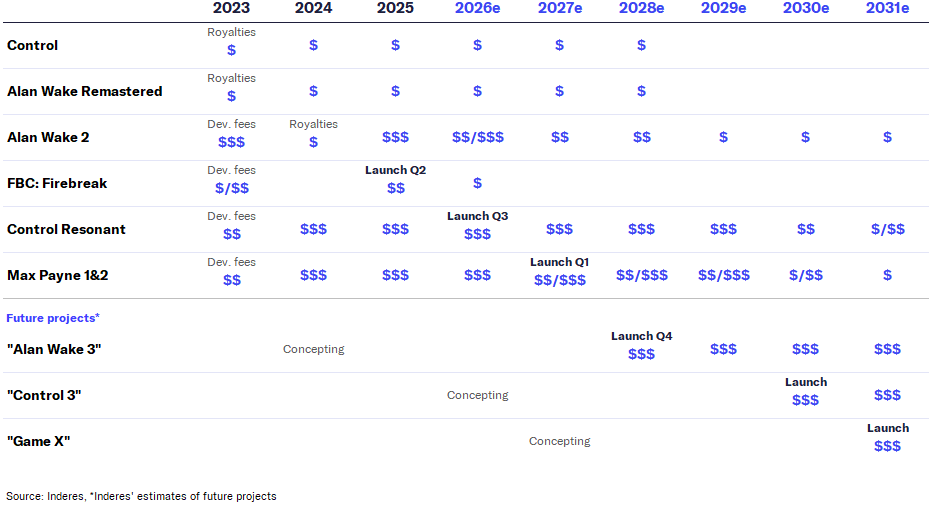
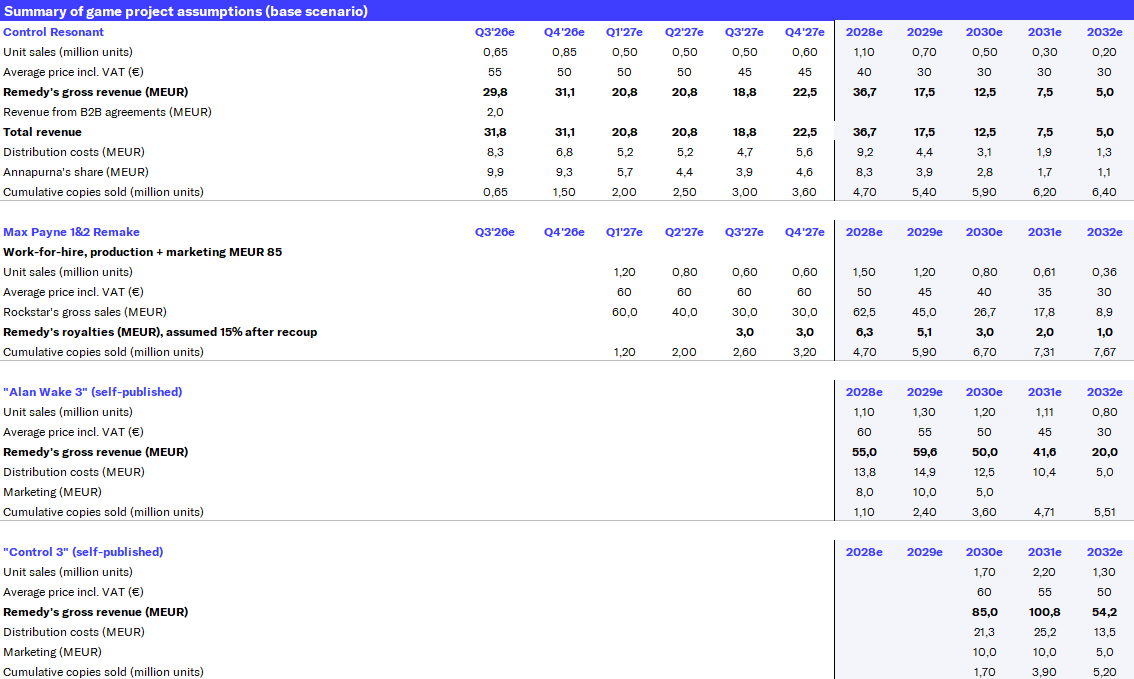
Game-specific assumptions
Near-term estimates
Estimates for 2026
Remedy expects 2026 revenue (2025: 59.5 MEUR) and EBITDA (2025: 11.3 MEUR) to increase from the previous year. Based on our estimates, the guidance will be clearly exceeded with the release of Control Resonant.
We expect Remedy’s revenue for 2026 to grow by 68% to 99.7 MEUR and EBITDA to rise to 15.9 MEUR. We estimate that Control Resonant will sell a total of 1.5 million copies in 2026. According to our estimate, Q3 accounted for around 0.65 million copies.
We expect development fees to total around 23 MEUR this year, which still requires roughly 4 MEUR in revenue from the Max Payne project in Q4.
Depreciation and amortization (2026e: 16.4 MEUR) will increase as the depreciation of Control Resonant begins, and therefore EBIT will remain slightly in the red in our estimate (-0.6 MEUR).
We expect Q4 revenue of 36.8 MEUR and EBITDA of 8.6 MEUR. We assume Control Resonant will sell 0.85 million copies in Q4, of which around 0.2 million are physical copies. We have set the average digital sales price for Q4 at EUR 50 due to stiff competition and Christmas season markdowns. According to Remedy, marketing will continue in Q4 at a clearly lower level than in Q3, and external development costs will also fall significantly.
Estimates for 2027
In 2027, we estimate that Remedy's revenue will grow by 13% to 113 MEUR and adjusted EBITDA will rise to 23.2 MEUR (20.6% of revenue). In our estimate, EBIT grows to 8,5 MEUR.
We estimate that Control Resonant will sell approximately 2.1 million copies in 2027 at a declining average price. Based on our estimates, Annapurna's share of the game's production budget will be recouped in early 2027. After this, we assume Annapurna's share to be 30% of the game's net revenue, which increases Remedy's share of the game's proceeds.
Another new driver is the Max Payne 1&2 Remake, which we expect to be released in early 2027. Rockstar will decide the release date, so there is still uncertainty regarding it. We assume the production and marketing budget of the game to be around 85 MEUR and that the game will sell around 3.2 million copies in 2027. Under our estimate, Remedy's royalties will not begin until Q3'27 once Rockstar has covered its costs. We assume Remedy's share of game sales to be 15% thereafter. All of these assumptions involve uncertainty, and therefore, visibility into royalties is very low at this point.
Our 2027 estimate currently still assumes 18 MEUR of revenue from development fees. If Remedy does not start a new subcontracting project after the Max Payne project, it would naturally no longer generate development fees. In this scenario, the company would invest even more aggressively in the development of its own game projects, which would increase long-term potential but weaken short-term earnings performance. However, launching a new subcontracting project remains possible, and the company's financial position might not be sufficient for the simultaneous development of three major proprietary projects.
Estimates for 2028-2029
In 2028, we estimate that the revenue will grow by 7.5% to 123 MEUR and adjusted EBITDA will be 32.3 MEUR (26.2% of revenue). In our estimate, EBIT grows to 18,0 MEUR. Growth is supported by Max Payne royalties and a yet-unnamed new project, which we assume is Alan Wake 3. We assume the game will be released in Q4'28 and will sell around 1.1 million copies in its launch quarter.
In 2029, we expect revenue to decline to 106 MEUR and EBITDA to 22.7 MEUR, as the year does not feature any major new game releases. However, the yet-unnamed project launched at the end of the previous year will continue to significantly support full-year revenue as sales continue. At the same time, the game's depreciation weighs on EBIT, bringing it to 5.5 MEUR in our estimate. Due to the timing of game releases, Remedy's figures will continue to fluctuate in our estimates for several years to come.
Long-term estimates
We find the long-term outlook for Remedy's business to be good. Self-publishing brings the company a larger share of game revenues than before, and Control Resonant demonstrated the company's ability to publish major games by itself. However, precise visibility into the long-term development of revenue and earnings is weak. With successful game releases, revenue should remain on a growth path in the long term, as the catalog of older games generates revenue on top of which new releases provide growth impulses.
Our long-term estimates assume successful game releases from Remedy, which enable growth and good profitability. The growth is unlikely to be steady, but the timing of the game releases will continue to swing the annual figures.
We estimate Remedy's revenue to rise from 106 MEUR to around 195 MEUR in 2029-2031. The largest revenue impacts of the forecast period fall in 2031, as we expect the next Control game to be released in 2030 and yet another new game in 2031. In addition, older games continue to generate revenue. This is also when we expect profitability to peak, with the EBIT margin reaching 28.5%. Thereafter, we expect annual revenue to stabilize at around 140-185 MEUR and the EBIT margin to be 25-26%. At this stage, capitalization and depreciation should be in a fairly good balance. EBIT would thus convert into free cash flow at a good rate.
Self-publishing will result in a slight deterioration in Remedy's relative profitability, because distribution costs will flow through the income statement and increase revenue. However, in a very best-case scenario, Remedy still has the potential for even better profitability than we estimate. For quality console and PC game studios, EBIT margins of over 40% are not unprecedented.
| 2024 | Q1'25 | Q2'25 | Q3'25 | Q4'25 | 2025 | Q1'26 | Q2'26 | Q3'26 | Q4'26e | 2026e | 2027e | 2028e | 2029e | |
|---|---|---|---|---|---|---|---|---|---|---|---|---|---|---|
| Revenue | 50.7 | 13.4 | 16.9 | 12.2 | 17.0 | 59.5 | 13.1 | 10.2 | 39.6 | 36.8 | 99.7 | 112.7 | 123.2 | 106.1 |
| Development fees | 45.6 | 10.7 | 7.4 | 6.1 | 8.7 | 32.9 | 8.2 | 6.4 | 4.3 | 4.0 | 22.9 | 18.0 | 20.0 | 20.0 |
| Royalties | 5.1 | 2.1 | 2.1 | 2.1 | 4.1 | 10.5 | 2.7 | 1.2 | 0.7 | 1.2 | 5.8 | 10.6 | 10.5 | 8.4 |
| Sales of own games | 0.0 | 0.5 | 7.4 | 3.9 | 4.2 | 16.1 | 2.3 | 2.6 | 34.6 | 31.6 | 71.0 | 84.1 | 92.7 | 77.8 |
| EBITDA | 2.5 | 2.6 | 4.2 | 0.7 | 3.9 | 11.3 | 2.9 | -2.4 | 6.8 | 8.6 | 15.9 | 23.2 | 32.3 | 22.7 |
| Depreciation, amortization and impairment | -6.8 | -1.3 | -4.7 | -17.1 | -3.1 | -26.2 | -1.9 | -1.6 | -6.2 | -6.8 | -16.4 | -14.7 | -14.3 | -17.2 |
| EBIT excluding one-offs | -4.3 | 1.3 | -0.5 | -16.4 | 0.7 | -14.9 | 1.0 | -3.9 | 0.6 | 1.8 | -0.6 | 8.5 | 18.0 | 5.5 |
| EBIT | -4.3 | 1.3 | -0.5 | -16.4 | 0.7 | -14.9 | 1.0 | -3.9 | 0.6 | 1.8 | -0.6 | 8.5 | 18.0 | 5.5 |
| Net financial expenses | 0.5 | -0.2 | -0.1 | -0.3 | -0.3 | -0.8 | -0.3 | 0.0 | -0.6 | -0.1 | -1.0 | -0.5 | -0.5 | -0.1 |
| Profit before taxes | -3.8 | 1.1 | -0.6 | -16.7 | 0.5 | -15.7 | 0.8 | -3.9 | -0.0 | 1.6 | -1.5 | 8.0 | 17.5 | 5.4 |
| Taxes | 0.2 | -0.5 | -0.0 | 3.2 | -0.1 | 2.7 | -0.3 | 0.7 | -0.1 | -0.3 | -0.0 | -1.4 | -3.1 | -1.0 |
| Net profit | -3.6 | 0.6 | -0.6 | -13.5 | 0.4 | -13.0 | 0.5 | -3.2 | -0.1 | 1.3 | -1.5 | 6.6 | 14.3 | 4.5 |
| EPS (adjusted) | -0.27 | 0.04 | -0.04 | -0.99 | 0.03 | -0.96 | 0.03 | -0.24 | -0.01 | 0.10 | -0.11 | 0.48 | 1.03 | 0.30 |
| EPS (reported) | -0.27 | 0.04 | -0.04 | -0.99 | 0.03 | -0.96 | 0.03 | -0.24 | -0.01 | 0.10 | -0.11 | 0.48 | 1.03 | 0.30 |
| Key figures | ||||||||||||||
| Revenue growth % | 49.3 % | 24.1 % | 63.5 % | -32.0 % | 46.2 % | 17.5 % | -1.9 % | -40.0 % | 226.1 % | 115.9 % | 67.6 % | 13.0 % | 9.3 % | -13.8 % |
| EBITDA % | 5.0 % | 19.3 % | 24.9 % | 5.7 % | 22.7 % | 19.1 % | 22.3 % | -23.6 % | 17.1 % | 23.3 % | 15.9 % | 20.6 % | 26.2 % | 21.4 % |
| Adjusted EBIT-% | -8.4 % | 9.7 % | -2.7 % | -135.1 % | 4.3 % | -25.0 % | 7.8 % | -38.8 % | 1.5 % | 4.8 % | -0.6 % | 7.5 % | 14.6 % | 5.2 % |
| Net profit-% | -7.1 % | 4.4 % | -3.4 % | -110.7 % | 2.4 % | -21.9 % | 3.6 % | -31.9 % | -0.3 % | 3.6 % | -1.6 % | 5.8 % | 11.6 % | 4.2 % |
| Source: Inderes | ||||||||||||||
Valuation
Updated:
Valuation and investment view
Remedy's long-term potential is attractive
In the long term, the ability of Remedy’s team to create high-quality games, favorable market trends, and a strengthened position in the value chain through self-publishing offer the company good preconditions to grow into a significantly larger game developer than currently. The successful launch of Control Resonant proved that Remedy is capable of developing and publishing a major game on its own. The multi-project model also brings attractive optionality from the viewpoint of the risk/reward ratio of the company’s business model. The revenue potential of a single game from Remedy's perspective ranges from tens of millions to hundreds of millions of euros, depending on the publishing model, so the range of possible outcomes is wide. With the multi-project model, the pace of game releases will quicken and the number of "success options" will rise in the future. We estimate that with only relatively well-succeeding games, Remedy’s growth outlook is good far into the future.
Valuation multiples will fall to a low level with earnings growth
With the release of Control Resonant, Remedy is moving from the investment phase of its strategy to a phase of profitable growth. Earnings growth driven by new game releases will thus also support the valuation on earnings-based multiples. Based on our estimates, the EV/EBITDA multiples for 2027-2028 (8x-6x) are very low. Given the timing of game releases, Remedy’s earnings, and consequently its valuation multiples, will continue to fluctuate for years to come. At the EBIT level, amortization of capitalized development costs is likely to keep causing volatility in the figures even toward the end of the decade.
In our opinion, Remedy's revenue-based valuation also looks moderate relative to the company's growth and profitability potential. This year's EV/S ratio is 2.0x, and in 2027-2028, the multiple will drop to 1.7x-1.5x. We remind you that the gross revenue recognition of self-publishing increases revenue, meaning that the revenue multiples are not fully comparable to Remedy's history.
The long sales tail of Control Resonant and Max Payne drivers for the coming year
In our view, the successful launch of Control Resonant has reduced Remedy’s near-term risks, as the scenario of a failed launch is now off the table. The game is shaping up to be a commercial success for Remedy, and we estimate that its cash flows, together with an already strong balance sheet, will enable the company to finance and self-publish future projects. The game also strengthens the Control brand and expands the player base, laying a foundation for future games.
The hit-game option did not materialize, however, and early sales have been somewhat more modest than we expected. Thus, the short-term surprise element has, to some extent, been priced out of the share. Resonant's sales curve could still surprise in either direction in the coming years. Over the next 12 months, we expect the share to be supported by continued Resonant sales and the likely release of Max Payne 1&2 Remake. We remind investors that they must continue to be prepared to tolerate the high price volatility that changes in expectations for future games can cause.
Remedy is theoretically a potential acquisition target, but its ownership structure imposes constraints on this
In the consolidation of the gaming market, many independent game studios like Remedy have already merged to become part of a larger player. Consolidation has also extended to the largest companies in the industry, as a decision was made to take Electronic Arts private in 2025. In theory, all the big market players and publishers are potential buyer candidates in Remedy's case as well.
In our view, the clearest candidate is Tencent, whose ownership in Remedy could rise to ~20% following the conversion of the convertible bond. With its shareholding, Tencent could also fend off other potential takeover bids. Mariatorp entered Remedy's shareholder list this year with a stake of ~9%. In our view, the emergence of a long-term anchor shareholder indicates that a takeover bid is not likely in the near term.
Looking out to the end of the decade, however, the likelihood of a takeover bid gradually increases. If Remedy succeeds in executing its strategy, the stock would likely be at a very different valuation level. This could provide a good exit point for the company's owners. From a buyer's perspective, Remedy would have then proven its ability to self-publish successful games and strengthened the game brands it owns.
We find the valuation of the share attractive relative to its potential
Remedy's value relies on cash flows generated far in the future, to which precise visibility is naturally weak. Therefore, valuation should be approached through scenarios to assess the expectations priced into the share and the risk/reward ratio. In the baseline DCF scenario, we assume successful game releases, resulting in a share value of approximately EUR 22.8. In the optimistic scenario, the stock could multiply, but in a bearish scenario, there is still plenty of room for downside. The baseline case is clearly above the current share price, so we consider the valuation of the share attractive if one believes in the success of Remedy's future games. After the price drop, we raise our recommendation to Buy (from Accumulate), but reiterate our EUR 21.0 target price.
| 2022 | 2023 | 2024 | 2025 | 2026e | 2027e | 2028e | 2029e | |
|---|---|---|---|---|---|---|---|---|
| Share price | 21.85 | 25.40 | 14.06 | 15.20 | 15.04 | 15.04 | 15.04 | 15.04 |
| Number of shares, million | 13.45 | 13.49 | 13.53 | 13.59 | 13.69 | 13.79 | 13.89 | 14.80 |
| Market cap | 293.9 | 342.6 | 190.9 | 206.6 | 205.9 | 207.4 | 208.9 | 222.6 |
| Enterprise Value (EV) | 241.0 | 315.9 | 165.6 | 195.4 | 196.5 | 190.8 | 179.8 | 173.3 |
| P/E (adj.) | neg. | neg. | neg. | neg. | neg. | 31.7 | 14.6 | 49.9 |
| P/E | neg. | neg. | neg. | neg. | neg. | 31.7 | 14.6 | 49.9 |
| P/B | 3.3 | 5.1 | 2.8 | 3.7 | 3.7 | 3.4 | 2.8 | 2.3 |
| P/S | 6.7 | 10.1 | 3.8 | 3.5 | 2.1 | 1.8 | 1.7 | 2.1 |
| EV/S | 5.5 | 9.3 | 3.3 | 3.3 | 2.0 | 1.7 | 1.5 | 1.6 |
| EV/EBITDA | >100 | neg. | 65.9 | 17.2 | 12.4 | 8.2 | 5.6 | 7.6 |
| EV/EBIT (adj.) | neg. | neg. | neg. | neg. | neg. | 22.5 | 10.0 | 31.2 |
| Payout ratio (%) | neg. | 0.0 % | 0.0 % | 0.0 % | 0.0 % | 0.0 % | 0.0 % | 0.0 % |
| Dividend yield % | 0.5 % | 0.0 % | 0.0 % | 0.0 % | 0.0 % | 0.0 % | 0.0 % | 0.0 % |
| Source: Inderes | ||||||||
Peer group
Many pitfalls when comparing the valuations of gaming companies
We have compiled Remedy’s peer group mainly of companies that focus on console and PC games. The companies in the peer group vary widely in size and stage of development, and their growth and profitability profiles differ significantly.
Some companies have run into financial difficulties in recent years, which has driven their valuations very low. Others (e.g., Take-Two and CD Projekt), meanwhile, have expectations weighted toward large games to be launched in the near future or coming years, which keeps near-term multiples high. For others, the short-term valuation may appear low because a major game release took place in the ongoing fiscal year. Therefore, we do not believe that the median peer group valuation (2026e EV/S 2.1x and EV/EBITDA 6x) is a true reflection of the acceptable valuation of gaming companies. In the case of gaming companies, we believe each company must be examined as an individual.
Valuations of gaming companies saw a strong downward correction after the peak in demand brought on by the COVID pandemic (2020-2021). This was also influenced by the higher required returns resulting from rising interest rates, as well as company-specific challenges. Fears of disruption created by AI have weakened sentiment regarding gaming companies as well this year, although the worst of the panic has subsided since the beginning of the year. For game companies like Remedy, we consider these fears to be overblown. We believe there will continue to be demand for quality game brands, and their role may even be emphasized in the age of AI.
Quality gaming companies still trade at high multiples. For example, CD Projekt and Take-Two have EV/EBIT multiples of around 30x and 24x for next year, and Paradox around 20x. However, for these companies as well, the multiples will drop clearly with the expected game releases.
| Market cap | Enterprise value | EV/EBIT | EV/EBITDA | EV/S | Revenue growth % | EBIT-% | ||||||
|---|---|---|---|---|---|---|---|---|---|---|---|---|
| MEUR | MEUR | 2026e | 2027e | 2026e | 2027e | 2026e | 2027e | 2026e | 2027e | 2026e | 2027e | |
| Frontier Developments | 234 | 202 | 17.5 | 11.4 | 8.4 | 5.1 | 1.7 | 1.6 | 12 % | 2 % | 9 % | 14 % |
| Embracer | 1,860 | 1,598 | 14.3 | 9.1 | 3.6 | 3.3 | 1.0 | 0.9 | -28 % | 9 % | 7 % | 10 % |
| Starbreeze | 14 | 10 | 3.3 | 3.0 | 1.0 | 1.2 | -45 % | 6 % | -87 % | -28 % | ||
| CD Projekt | 6,010 | 5,815 | 60.6 | 29.9 | 51.7 | 24.0 | 28.9 | 14.7 | -5 % | 96 % | 48 % | 49 % |
| Paradox Interactive | 1,372 | 1,311 | 19.5 | 16.8 | 11.6 | 9.3 | 6.9 | 5.8 | -8 % | 18 % | 35 % | 35 % |
| Coffee Stain | 397 | 329 | 12.9 | 14.9 | 6.3 | 6.7 | 3.8 | 3.3 | 13 % | 29 % | 22 % | |
| Playway | 377 | 328 | 7.5 | 7.1 | 6.6 | 6.2 | 4.4 | 4.1 | 11 % | 7 % | 59 % | 59 % |
| 11 Bit Studios | 59 | 48 | 68.0 | 5.2 | 6.8 | 2.1 | 2.3 | -26 % | -10 % | 3 % | -2 % | |
| The recommendation policy consists of four tiers: Sell, Reduce, Accumulate, and Buy | 122 | 124 | 5.1 | 3.7 | 3.1 | 0.8 | 0.7 | 10 % | 10 % | -10 % | 14 % | |
| Tinybuild | 52 | 48 | 65.4 | 7.4 | 8.2 | 1.0 | 1.1 | 54 % | -12 % | -4 % | 2 % | |
| CI Games | 118 | 128 | 4.0 | 2.4 | 3.2 | 2.0 | 9.3 | 1.2 | 25 % | 693 % | 230 % | 49 % |
| Take-Two Interactive | 34,694 | 35,449 | 40.9 | 23.9 | 35.4 | 22.9 | 5.9 | 4.5 | 18 % | 30 % | 14 % | 19 % |
| Ubisoft | 603 | 977 | 2.5 | 2.4 | 0.7 | 0.7 | -20 % | -5 % | -47 % | -8 % | ||
| Remedy (Inderes) | 206 | 196 | -349.6 | 22.5 | 12.4 | 8.2 | 2.0 | 1.7 | 68 % | 13 % | -1 % | 8 % |
| Average | 27.2 | 18.6 | 11.4 | 7.9 | 5.2 | 3.3 | -0 % | 61 % | 20 % | 17 % | ||
| Median | 17.5 | 13.2 | 6.3 | 6.2 | 2.1 | 1.6 | 0 % | 8 % | 8 % | 14 % | ||
| Difference % vs. median | -2,093 % | 71 % | 95 % | 34 % | -4 % | 4 % | ||||||
| Source: Refinitiv / Inderes | ||||||||||||
In our view, as the strategy progresses and future game projects succeed, Remedy would position itself among the highest quality game companies in its peer group. Therefore, this group can be used to outline Remedy's potential acceptable valuation level. These companies are also publishers of their own games, so they are relatively comparable in terms of revenue. From an investor's perspective, however, the value of a gaming company's revenue can vary significantly. A good example of this is Remedy's transition to a self-publisher, as distribution costs are now reflected in the company's revenue.
If Remedy reaches a more stable phase in the long term and earnings performance levels off, an acceptable EV/EBIT ratio could be in the range of 12x-20x, depending on growth prospects and stock market sentiment. Multiples at these levels would, to some extent, reflect the valuations of software companies that are making good profits. However, even in the longer term, one cannot get too hung up on any one year's multiples. Even for larger gaming companies, the timing of game releases continues to drive volatility in earnings.
DCF model and scenarios
DCF model is very sensitive to game success
We approach Remedy's DCF modeling through three scenarios to illustrate the sensitivity of the company's value to the success of future games. In particular, we have changed our assumptions about the sales volumes of future AAA games in the scenarios. With a fixed cost structure and self-publishing, the stock value can fluctuate over an exceptionally wide range between pessimistic and optimistic scenarios.
The value of Remedy's share in our DCF model in a baseline scenario based on our estimates is around EUR 22.8. Cash flows are heavily weighted far into the future and on the success of future games. In the baseline scenario, we assume that the major AAA games will sell around 4-5 million copies in the first three years.
The cost of capital (WACC) in our model is 10.8%. In light of high growth expectations and cash flows weighted far into the future, the required return must, in our view, justifiably be quite high.
In the optimistic scenario, we assume major AAA projects will sell around 6-7 million copies on average over three years, and Max Payne to outperform the baseline. In this scenario, Remedy's free cash flow would rise sharply, and, depending on the required return, the share value would even be well above EUR 40. The scenario also illustrates how, in a hit game, the last few million copies sold can dramatically improve the profitability of a single project.
In the pessimistic scenario, we expect the major AAA game projects to sell an average of about 3 million copies in three years, and Max Payne to be significantly below the baseline. In this case, we estimate that Remedy would need to cut its cost structure to achieve reasonable profitability. A smaller organization is also reflected in lower longer-term revenue estimates. Even in this scenario, Remedy would generate reasonable profits and cash flow over the long term, but the share value would be around EUR 7-9, depending on the required return.
Gauging Remedy’s long-term potential
Share price in different scenarios
| EV/EBIT 12x | |||||
|---|---|---|---|---|---|
| Revenue (MEUR) | |||||
| EBIT-% | 100 | 125 | 150 | 175 | 200 |
| 25 % | 21,3 | 26,3 | 31,3 | 36,3 | 41,3 |
| 30 % | 25,3 | 31,3 | 37,3 | 43,3 | 49,3 |
| 35 % | 29,3 | 36,3 | 43,3 | 50,3 | 57,3 |
| 40 % | 33,3 | 41,3 | 49,3 | 57,3 | 65,3 |
| EV/EBIT 16x | |||||
| Revenue (MEUR) | |||||
| EBIT-% | 100 | 125 | 150 | 175 | 200 |
| 25 % | 28,0 | 34,7 | 41,3 | 48,0 | 54,7 |
| 30 % | 33,3 | 41,3 | 49,3 | 57,3 | 65,3 |
| 35 % | 38,7 | 48,0 | 57,3 | 66,7 | 76,0 |
| 40 % | 44,0 | 54,7 | 65,3 | 76,0 | 86,7 |
| EV/EBIT 20x | |||||
| Revenue (MEUR) | |||||
| EBIT-% | 100 | 125 | 150 | 175 | 200 |
| 25 % | 34,7 | 43,0 | 51,3 | 59,7 | 68,0 |
| 30 % | 41,3 | 51,3 | 61,3 | 71,3 | 81,3 |
| 35 % | 48,0 | 59,7 | 71,3 | 83,0 | 94,7 |
| 40 % | 54,7 | 68,0 | 81,3 | 94,7 | 108,0 |
- The scenarios aim to illustrate Remedy's share price if the company achieves a sustainable revenue of 100-200 MEUR with an EBIT margin of 25-40%.
- If the company's game projects perform well, we see the revenue and profitability potential to reach these levels over the next five years.
- The scenarios assume Remedy's net cash to be 20 MEUR and the number of shares to be 15 million (accounting for the dilution of stock option schemes and convertible bond).
- In terms of valuation multiples, we believe that an EV/EBIT multiple of 12x would reflect a scenario where Remedy's future growth prospects would be weak, 16x good, and 20x very good.
Appendices
Updated:
| 2025 | 2026e | 2027e | 2028e | |
|---|---|---|---|---|
| Revenue | 59.5 | 99.7 | 112.7 | 123.2 |
| Growth-% | 17 % | 68 % | 13 % | 9 % |
| EBIT adj. | -14.9 | -0.6 | 8.5 | 18.0 |
| EBIT-% adj. | -25.0 % | -0.6 % | 7.5 % | 14.6 % |
| Net profit | -13.0 | -1.5 | 6.6 | 14.3 |
| EPS (adj.) | -0.96 | -0.11 | 0.48 | 1.03 |
| P/E (adj.) | neg. | neg. | 31.7 | 14.6 |
| P/B | 3.7 | 3.7 | 3.4 | 2.8 |
| Dividend yield % | 0.0 % | 0.0 % | 0.0 % | 0.0 % |
| EV/EBIT (adj.) | neg. | neg. | 22.5 | 10.0 |
| EV/EBITDA | 17.2 | 12.4 | 8.2 | 5.6 |
| EV/S | 3.3 | 2.0 | 1.7 | 1.5 |
| Source: Inderes | ||||
| 2024 | 2025 | 2026e | 2027e | 2028e | |
|---|---|---|---|---|---|
| Assets | |||||
| Non-current assets | 52.0 | 42.8 | 42.8 | 44.1 | 45.8 |
| Goodwill | 0.0 | 0.0 | 0.0 | 0.0 | 0.0 |
| Intangible assets | 39.8 | 27.9 | 28.3 | 30.0 | 32.0 |
| Fixed assets | 5.8 | 5.8 | 5.5 | 5.1 | 4.8 |
| Investments in associated companies | 0.0 | 0.0 | 0.0 | 0.0 | 0.0 |
| Other investments | 0.0 | 0.0 | 0.0 | 0.0 | 0.0 |
| Other non-current assets | 1.0 | 0.8 | 0.8 | 0.8 | 0.8 |
| Deferred tax assets | 5.4 | 8.3 | 8.3 | 8.3 | 8.3 |
| Current assets | 47.3 | 44.8 | 42.4 | 49.6 | 63.6 |
| Inventories | 0.0 | 0.0 | 0.0 | 0.0 | 0.0 |
| Other current assets | 0.0 | 0.0 | 0.0 | 0.0 | 0.0 |
| Accounts receivable | 6.2 | 15.4 | 17.0 | 16.9 | 18.5 |
| Liquid assets | 41.1 | 29.4 | 25.4 | 32.7 | 45.2 |
| Balance sheet total | 99.3 | 87.5 | 85.2 | 93.7 | 109.5 |
| Equity and liabilities | |||||
| Equity | 68.5 | 56.6 | 55.0 | 61.6 | 75.9 |
| Share capital | 0.1 | 0.1 | 0.1 | 0.1 | 0.1 |
| Retained earnings | 10.1 | -1.7 | -3.2 | 3.3 | 17.6 |
| Equity-like loans | 0.0 | 0.0 | 0.0 | 0.0 | 0.0 |
| Revaluation reserve | 0.0 | 0.0 | 0.0 | 0.0 | 0.0 |
| Other equity | 58.3 | 58.2 | 58.2 | 58.2 | 58.2 |
| Minority interest | 0.0 | 0.0 | 0.0 | 0.0 | 0.0 |
| Non-current liabilities | 14.6 | 17.2 | 15.2 | 16.1 | 16.1 |
| Deferred tax liabilities | 0.1 | 0.2 | 0.2 | 0.2 | 0.2 |
| Provisions | 0.0 | 0.0 | 0.0 | 0.0 | 0.0 |
| Interest-bearing liabilities | 14.5 | 17.0 | 15.0 | 15.9 | 15.9 |
| Convertible bonds | 0.0 | 0.0 | 0.0 | 0.0 | 0.0 |
| Other non-current liabilities | 0.0 | 0.0 | 0.0 | 0.0 | 0.0 |
| Current liabilities | 16.2 | 13.8 | 15.0 | 16.0 | 17.4 |
| Interest-bearing liabilities | 1.4 | 1.3 | 1.0 | 0.2 | 0.2 |
| Current non-interest-bearing liabilities | 14.8 | 12.5 | 14.0 | 15.8 | 17.2 |
| Other current liabilities | 0.0 | 0.0 | 0.0 | 0.0 | 0.0 |
| Balance sheet total | 99.3 | 87.5 | 85.2 | 93.7 | 109.5 |
| Source: Inderes | |||||
| 2025 | 2026e | 2027e | 2028e | 2029e | 2030e | 2031e | 2032e | 2033e | 2034e | 2035e | 2036e | 2037e | 2038e | TERM | |
|---|---|---|---|---|---|---|---|---|---|---|---|---|---|---|---|
| Revenue growth % | 17.5 % | 67.6 % | 13.0 % | 9.3 % | -13.8 % | 43.7 % | 28.0 % | -27.7 % | 12.0 % | 3.0 % | 3.0 % | 3.0 % | 3.0 % | 3.0 % | 3.0 % |
| EBIT margin | -25.0 % | -0.6 % | 7.5 % | 14.6 % | 5.2 % | 19.4 % | 28.5 % | 17.2 % | 25.0 % | 26.0 % | 26.0 % | 26.0 % | 26.0 % | 25.5 % | 25.5 % |
| EBIT | -14.9 | -0.6 | 8.5 | 18.0 | 5.5 | 29.6 | 55.5 | 24.3 | 39.5 | 42.3 | 43.6 | 44.9 | 46.3 | 46.7 | |
| + Total depreciation | 26.2 | 16.4 | 14.7 | 14.3 | 17.2 | 16.6 | 16.4 | 16.2 | 16.1 | 16.1 | 16.1 | 17.2 | 17.1 | 17.1 | |
| - Taxes paid | -0.2 | -0.0 | -1.4 | -3.1 | -1.0 | -5.3 | -10.0 | -4.4 | -7.1 | -7.6 | -7.8 | -8.1 | -8.3 | -8.4 | |
| - taxes from financial expenses | -0.1 | 0.0 | -0.1 | -0.1 | -0.0 | -0.0 | -0.0 | -0.0 | -0.0 | -0.0 | -0.0 | -0.0 | -0.0 | -0.0 | |
| + taxes from financial income | 0.0 | 0.0 | 0.0 | 0.0 | 0.0 | 0.0 | 0.0 | 0.0 | 0.0 | 0.0 | 0.0 | 0.0 | 0.0 | 0.0 | |
| - Change in working capital | -11.5 | -0.1 | 1.9 | -0.1 | -0.4 | 0.1 | -2.4 | 1.1 | -0.3 | -0.1 | -0.1 | -0.1 | -0.1 | -0.1 | |
| Operational cash flow | -0.5 | 15.8 | 23.5 | 28.9 | 21.4 | 41.0 | 59.5 | 37.3 | 48.2 | 50.7 | 51.7 | 53.9 | 55.0 | 55.3 | |
| + Increase in non-interest-bearing non-current liabilities | 0.0 | 0.0 | 0.0 | 0.0 | 0.0 | 0.0 | 0.0 | 0.0 | 0.0 | 0.0 | 0.0 | 0.0 | 0.0 | 0.0 | |
| - Gross investments | -14.0 | -16.5 | -16.0 | -16.0 | -16.0 | -16.0 | -16.0 | -16.0 | -16.0 | -16.0 | -17.0 | -17.0 | -17.0 | -17.0 | |
| Free operational cash flow | -14.5 | -0.7 | 7.5 | 12.9 | 5.4 | 25.0 | 43.5 | 21.3 | 32.2 | 34.7 | 34.7 | 36.9 | 38.0 | 38.3 | |
| +/- Others | 0.0 | 0.0 | 0.0 | 0.0 | 0.0 | 0.0 | 0.0 | 0.0 | 0.0 | 0.0 | 0.0 | 0.0 | 0.0 | 0.0 | |
| Free cash flow | -14.5 | -0.7 | 7.5 | 12.9 | 5.4 | 25.0 | 43.5 | 21.3 | 32.2 | 34.7 | 34.7 | 36.9 | 38.0 | 38.3 | |
| Discounted free cash flow | -0.7 | 6.7 | 10.4 | 3.9 | 16.4 | 25.8 | 11.4 | 15.5 | 15.1 | 13.7 | 13.1 | 12.2 | 11.1 | 146.9 | |
| Discounted cumulative FCF | 301.5 | 302.2 | 295.5 | 285.1 | 281.2 | 264.8 | 239.0 | 227.6 | 212.1 | 197.0 | 183.3 | 170.2 | 158.0 | 146.9 |
| Enterprise value DCF | 301.5 |
| - Interest-bearing liabilities | -18.3 |
| + Cash and cash equivalents | 29.4 |
| + Affiliates | 0.0 |
| - Minority interest | 0.0 |
| - Dividend / capital return | 0.0 |
| Equity value DCF | 312.6 |
| Equity value DCF per share | 22.8 |
| Cost of equity | 10.8 % |
| Weighted average cost of capital (WACC) | 10.8 % |
Input parameters
| Tax rate – WACC | 20.0 % |
| Targeted gearing D/(D+E) | 0.0 % |
| Cost of debt | 5.0 % |
| Company beta | 1.30 |
| Market risk premium | 4.8 % |
| Liquidity premium | 1.6 % |
| Risk-free rate | 3.0 % |
Disclaimer and recommendation history
Updated:
This disclaimer applies to written, video and audio reports and other content related to stock research produced by Inderes Oyj (hereinafter referred to as "Inderes") or published on the inderes.fi website or other distribution channels of Inderes (hereinafter collectively referred to as "reports"). This disclaimer contains important information regarding Inderes’ stock research, including investment recommendations.
Inderes engages in commissioned stock research for certain companies under its monitoring. In this arrangement, the monitored company compensates Inderes for delivering independent stock research. Information required to be given by law related to investment recommendations, but not covered in this general disclaimer, is available in the company reports on the respective company’s page on the Inderes website.
No part of this report, or the report as a whole, shall be transferred or shared in any form to the United States, Canada or Japan or the citizens of the aforementioned countries. The legislation of other countries may also lay down restrictions pertaining to the distribution of the information contained in this report. Any individuals who may be subject to such restrictions must take said restrictions into account.
The information presented in Inderes reports is obtained from several different public sources that Inderes considers to be reliable. Inderes aims to use reliable and comprehensive information, but Inderes does not guarantee the accuracy of the presented information. Any opinions, estimates and forecasts represent the views of the authors. Inderes is not responsible for the content or accuracy of the presented information. Inderes and its employees are also not responsible for the financial outcomes of investment decisions made based on the reports or any direct or indirect damage caused by the use of the information. The information used in producing the reports may change quickly. Inderes makes no commitment to announce any potential changes to the presented information and opinions.
The reports produced by Inderes are intended for informational use only. The reports should not be construed as offers or advice to buy, sell or subscribe investment products. Customers should also understand that past performance is not a guarantee of future results. When making investment decisions, customers must base their decisions on their own research and their estimates of the factors that influence the value of the investment and consider their objectives and financial position and use advisors as necessary. Customers are responsible for their investment decisions and their financial outcomes.
Reports produced by Inderes may not be edited, copied or made available to others in their entirety, or in part, without Inderes’ written consent.
Inderes issues target prices for the shares it follows. The recommendation methodology used by Inderes is based on the share’s 12-month expected total shareholder return (including the share price and dividends) and considers Inderes’ view of the risk associated with the expected returns. The recommendation policy consists of four tiers: Sell, Reduce, Accumulate and Buy. As a rule, Inderes’ investment recommendations and target prices are reviewed at least 2–4 times per year in connection with the companies’ interim reports, but the recommendations and target prices may also be changed at other times depending on the market conditions. The issued recommendations and target prices do not guarantee that the share price will develop in line with the estimate. Inderes primarily uses the following valuation methods in determining target prices and recommendations: Cash flow analysis (DCF), valuation multiples, peer group analysis and sum of the parts analysis. The valuation methods and target price criteria used are always company-specific and they may vary significantly depending on the company and (or) industry.
Inderes’ recommendation policy is based on the following distribution relative to the 12-month risk-adjusted expected total shareholder return.
Buy - The 12-month risk-adjusted expected shareholder return of the share is very attractive
Accumulate - The 12-month risk-adjusted expected shareholder return of the share is attractive
Reduce - The 12-month risk-adjusted expected shareholder return of the share is weak
Sell - The 12-month risk-adjusted expected shareholder return of the share is very weak
The assessment of the 12-month risk-adjusted expected total shareholder return based on the above-mentioned definitions is company-specific and subjective. Consequently, similar 12-month expected total shareholder returns between different shares may result in different recommendations, and the recommendations and 12-month expected total shareholder returns between different shares should not be compared with each other. The counterpart of the expected total shareholder return is Inderes’ view of the risk taken by the investor, which varies considerably between companies and scenarios. Thus, a high expected total shareholder return does not necessarily lead to positive performance when the risks are exceptionally high and, correspondingly, a low expected total shareholder return does not necessarily lead to a negative recommendation if Inderes considers the risks to be moderate.
The analysts who produce Inderes’ research and Inderes employees cannot have 1) shareholdings that exceed the threshold of significant financial gain or 2) shareholdings exceeding 1% in any company subject to Inderes’ research activities. Inderes can only own shares in the target companies it follows to the extent shown in the company’s model portfolio and/or femme portfolio investing real funds. All of Inderes' shareholdings are presented in itemized form in the model and femme portfolio. Inderes does not have other shareholdings in the target companies analyzed. The remuneration of the analysts who produce the analysis are not directly or indirectly linked to the issued recommendation or views. Inderes does not have investment bank operations.
Inderes or its partners whose customer relationships may have a financial impact on Inderes may, in their business operations, seek assignments with various issuers with respect to services provided by Inderes or its partners. Thus, Inderes may be in a direct or indirect contractual relationship with an issuer that is the subject of research activities. Inderes and its partners may provide investor relations services to issuers. The aim of such services is to improve communication between the company and the capital markets. These services include the organization of investor events, advisory services related to investor relations and the production of investor research reports.
Inderes has made an agreement with the issuer and target of this report, which entails compiling a research report.
Recommendation history
| Date | Recommendation | Target (EUR) | Share price (EUR) |
|---|---|---|---|
| 18/11/2026 | Buy | 21.00 | 15.04 |
| 03/11/2026 | Accumulate | 21.00 | 17.12 |
| 26/10/2026 | Accumulate | 23.00 | 17.08 |
| 27/09/2026 | Accumulate | 23.00 | 18.92 |
| 11/08/2026 | Buy | 21.00 | 16.88 |
| 05/05/2026 | Buy | 19.00 | 13.22 |
| 10/02/2026 | Buy | 19.00 | 14.86 |
| 16/12/2025 | Accumulate | 19.00 | 15.88 |
| 14/12/2025 | Accumulate | 19.00 | 16.50 |
| 29/10/2025 | Buy | 17.00 | 12.94 |
| 12/10/2025 | Buy | 17.00 | 13.20 |
| 24/09/2025 | Buy | 18.00 | 13.70 |
| 12/08/2025 | Accumulate | 18.00 | 15.94 |
| 31/07/2025 | Accumulate | 18.00 | 16.06 |
| 01/05/2025 | Buy | 20.00 | 16.42 |
| 12/02/2025 | Buy | 19.00 | 13.98 |
| 17/12/2024 | Buy | 19.00 | 13.50 |
| 19/11/2024 | Buy | 19.00 | 12.90 |
| 03/11/2024 | Accumulate | 19.00 | 15.32 |
| 04/09/2024 | Accumulate | 21.00 | 17.50 |
| 11/08/2024 | Accumulate | 20.00 | 17.20 |
| 29/04/2024 | Accumulate | 20.00 | 19.20 |
| 20/03/2024 | Accumulate | 19.00 | 16.70 |
| 18/02/2024 | Accumulate | 19.00 | 17.02 |
| 12/02/2024 | Accumulate | 21.00 | 17.62 |
| 06/02/2024 | Reduce | 21.00 | 21.60 |
| 04/02/2024 | Reduce | 29.00 | 23.85 |
| 15/11/2023 | Reduce | 29.00 | 28.85 |
| 31/10/2023 | Accumulate | 30.00 | 27.95 |
| 26/10/2023 | Accumulate | 30.00 | 27.00 |
| 13/09/2023 | Reduce | 24.00 | 22.50 |
| 13/08/2023 | Reduce | 25.00 | 25.55 |
| 11/06/2023 | Reduce | 25.00 | 26.10 |
| 26/04/2023 | Accumulate | 25.00 | 23.10 |
| 18/04/2023 | Accumulate | 25.00 | 24.20 |
| 12/02/2023 | Accumulate | 25.00 | 22.70 |
| 27/12/2022 | Accumulate | 25.00 | 21.50 |
| 30/10/2022 | Buy | 25.00 | 18.14 |
| 15/08/2022 | Accumulate | 26.00 | 22.50 |
| 02/06/2022 | Accumulate | 34.00 | 29.85 |
| 16/05/2022 | Buy | 42.00 | 29.30 |
| 14/02/2022 | Buy | 50.00 | 33.50 |
| 15/11/2021 | Buy | 50.00 | 40.75 |
| 14/09/2021 | Buy | 50.00 | 39.95 |
| 16/08/2021 | Accumulate | 50.00 | 43.00 |
| 12/05/2021 | Accumulate | 50.00 | 42.90 |
| 08/04/2021 | Accumulate | 50.00 | 43.75 |
| 26/02/2021 | Accumulate | 50.00 | 41.10 |
| 14/02/2021 | Accumulate | 50.00 | 45.00 |
| 09/12/2020 | Accumulate | 38.00 | 34.00 |
| 26/10/2020 | Accumulate | 33.00 | 29.00 |
| 16/08/2020 | Reduce | 33.00 | 33.80 |
| 21/04/2020 | Accumulate | 20.00 | 19.10 |
| 31/03/2020 | Buy | 18.00 | 14.00 |
| 17/02/2020 | Accumulate | 15.50 | 13.80 |
| 04/12/2019 | Accumulate | 11.50 | 10.25 |
| 14/08/2019 | Accumulate | 11.50 | 10.65 |
| 02/07/2019 | Accumulate | 10.00 | 9.12 |
| 13/02/2019 | Accumulate | 9.00 | 8.25 |
| 14/08/2018 | Buy | 8.50 | 6.76 |
| 03/06/2018 | Buy | 8.50 | 7.30 |
| 19/02/2018 | Buy | 7.50 | 5.90 |
| 17/08/2017 | Buy | 7.50 | 6.31 |
| 29/05/2017 | Accumulate | 7.40 | - |