Handelsbanken: The Swedish economy gears up as investment and consumption lift growth
Macro Forecast Sweden in brief
- Swedish GDP to grow by 2.6 percent in 2026, 2.4 percent in 2027 and 1.8 percent in 2028, adjusted for calendar effects.
- Households' real wages set to rise by an average of 2.2 percent this year, before the pace slows to just over 1 percent per year in 2027-28.
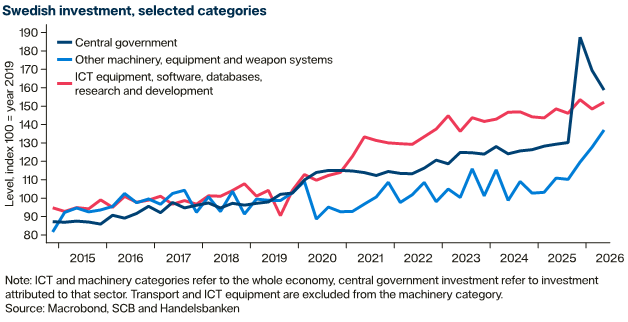
- Investment in defence, AI expansion, energy, and infrastructure continues to increase.
- The labour market strengthens and unemployment falls to around 7.5 percent by the end of 2028.
- The Riksbank is expected to raise the policy rate in two steps to 2.25 percent, starting in December this year.
- Fiscal policy is expected to become less expansionary in 2027, regardless of the election outcome.
The Swedish economy is picking up faster than expected. Increased purchasing power and major investments in defence, energy and AI are boosting growth. Handelsbanken's macroeconomists expect Swedish GDP to grow by 2.6 percent this year. "The Swedish economy has weathered the global turbulence of recent years. Multiple growth engines are working in tandem. Investment is rising, household finances are strengthening and business demand is growing. This creates favourable conditions for the Swedish economy in the years ahead", says Christina Nyman, Chief Economist at Handelsbanken.
In Sweden, the recovery was broad-based during the first half of 2026, and Swedish industry continues to show strength. In their latest Global Macro Forecast, Handelsbanken's macroeconomists assess that rising real wages, expansionary fiscal policy, growing exports and increased investment in defence, energy and AI will contribute to GDP growth of 2.6 percent this year, followed by 2.4 percent in 2027 and 1.8 percent in 2028.
"After several years of subdued economic activity, we now see a considerably broader recovery, with expansionary fiscal policy as an important driver. Fiscal policy will become less expansionary in the next parliamentary term, regardless of the election outcome, but previously approved spending, especially on defence, will continue to support growth", says Christina Nyman.
So far, companies have been able to meet rising demand using their existing workforce. The labour market has therefore continued to be characterised by high unemployment, but from 2027, the bank's economists expect a clear improvement.
The global economy has also shown greater resilience than expected. The effects of the conflict in the Middle East have, at least so far, been less extensive than feared, while the global investment cycle has strengthened. According to Handelsbanken's economists, three factors have been particularly important: the impact on oil prices has been smaller than expected; AI and increased defence spending are driving investment; and reduced uncertainty has strengthened financial conditions as well as household and business confidence.
Brighter prospects for small- and medium-sized enterprises in Sweden
The improved economic climate has helped lift the number of newly established enterprises by just over ten percent over the past year, with gains in both manufacturing and services. Moreover, the number of employees affected by bankruptcies has declined to a historically low level. Corporate bankruptcies remain elevated, however, driven primarily by failures among small businesses. Even so, the outlook is gradually brightening.
"Many small companies are still experiencing weak demand and squeezed profitability after several years of weak economic conditions. But the broad recovery we see ahead suggests that a turnaround is on the way for these businesses as well", states Christina Nyman.
The picture is mixed, however. While the defence buildup and investment in technology, energy, and infrastructure benefit many subcontractors, the outlook for housing construction is more subdued, against a backdrop of high construction costs and lower population growth. At the same time, stronger household purchasing power is boosting demand in many parts of the services sector.
Stronger purchasing power remains an important driver
Household finances have improved thanks to rising wages, lower inflation and fiscal support measures, and purchasing power will strengthen further in the coming years. Improved purchasing power has fuelled consumer spending, contributing to increased optimism among retailers. Although many households are financially better off, confidence in the future varies widely. High-income earners have a relatively positive view of their finances, while low-income earners are considerably more pessimistic. A similar gap can be seen between older and younger people.
"As the recovery gathers momentum, we expect labour market conditions to improve. This should improve sentiment among young people and lower-income households, groups that typically have a weaker foothold on the labour market", comments Christina Nyman.
Less expansionary fiscal policy ahead, regardless of election outcome
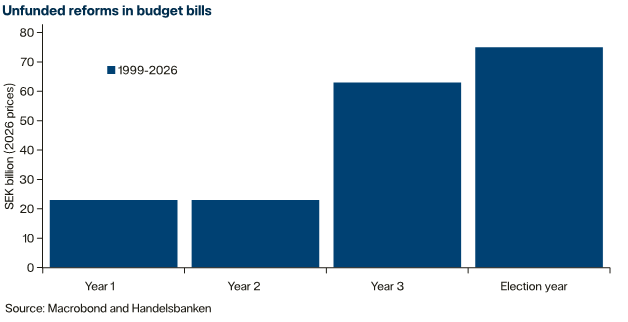
Public finances remain strong, and government debt has historically been largely unaffected by changes in political leadership. There is broad cross-party agreement that the defence buildup and support for Ukraine should be debt-financed, and that fiscal policy should otherwise be guided by a balanced budget target over the coming parliamentary term. Around SEK 15bn in unfunded reforms are expected next year, and fiscal policy is expected to remain mildly expansionary as previously adopted measures continue to feed through.
"Regardless of the election outcome, fiscal policy is expected to become less expansionary in the coming years. Both the government and several opposition parties have proposed measures to strengthen household finances, including tax cuts and higher benefits, but support to households will probably be less extensive than in the election year 2026", says Christina Nyman.
Housing market on the way up despite summer dip
The housing market strengthened during the spring, with around ten percent more housing transactions than the year before. After weaker developments during parts of the summer, we expect the upward trend in house prices to continue. House prices are expected to rise by just under six percent over the course of 2027 and just under four percent in 2028.
The Riksbank is expected to raise rates from December
Inflation is low at the moment, but part of the decline is temporary because it reflects tax cuts on items such as food and fuel. Underlying inflation is expected to rise as demand in the Swedish economy increases. In that situation, the Riksbank is expected to slowly normalise its monetary policy to prevent inflation from becoming too high. Handelsbanken's macroeconomists expect the Riksbank to raise the policy rate in two stages starting in December 2026, from the current 1.75 percent to 2.25 percent in June 2027.
"Households and businesses should assume that interest rates will be somewhat higher going forward than they are today, although we do not envisage any major increase", says Christina Nyman.
The krona is forecast to remain broadly stable for the rest of the year and then gradually appreciate in the years ahead, primarily against the euro. The Swedish recovery is expected to be stronger than that of the eurozone, and the interest rate differential between Sweden and the eurozone is expected to narrow, which favours the krona. By the end of 2027, one euro is expected to cost SEK 10.60.
For further information, please contact:
Christina Nyman, Chief Economist: +46 70 778 77 65
Handelsbanken's press office: +46 8 701 80 18, press@handelsbanken.se
For links to the webinar and the report, see Macro Forecast Sweden https://www.handelsbanken.se/sv/foretag/placera/konjunkturprognos
For more information about Handelsbanken, please visit: www.handelsbanken.com
| GDP Forecast | Annual average | |||
|
| 2025 | 2026 | 2027 | 2028 |
| Sweden* | 1.6 (1.8) | 2.6 (2.1) | 2.4 (2.5) | 1.8 (1.9) |
| Sweden, actual | 1.4 (1.5) | 2.9 (2.4) | 2.7 (2.7) | 1.5 (1.6) |
| Norway, mainland* | 1.7 (1.8) | 0.9 (1.4) | 1.1 (1.0) | 1.1 (1.1) |
| Eurozone | 1.3 (1.5) | 0.8 (0.8) | 1.2 (1.3) | 1.3 (1.4) |
| United Kingdom | 1.3 (1.4) | 1.1 (0.4) | 1.2 (0.9) | 1.4 (1.5) |
| United States* | 2.1 (2.1) | 2.1 (2.0) | 2.2 (1.9) | 1.9 (1.9) |
| China | 5.0 (5.0) | 4.5 (4.5) | 4.3 (4.3) | 4.0 (4.0) |
| *Kalenderjusterad |
|
|
|
|
| Interest rate forecast | End of year | |||
|
| 2025 | 2026 | 2027 | 2028 |
| United States | 3.625 (3.625) | 4.125 (3.625) | 4.125 (3.625) | 3.875 (3.625) |
| Eurozone | 2.00 (2.00) | 2.50 (2.50) | 2.25 (2.25) | 2.25 (2.25) |
| Sweden | 1.75 (1.75) | 2.00 (1.75) | 2.25 (2.25) | 2.25 (2.25) |
| United Kingdom | 3.75 (3.75) | 4.00 (3.75) | 3.75 (4.00) | 3.50 (4.00) |
| Norway | 4.00 (4.00) | 4.50 (4.50) | 4.25 (4.25) | 4.00 (4.00) |
| Exchange rate forecast | End of year | |||||||
|
| 2025 | 2026 | 2027 | 2028 | ||||
| EUR/SEK | 10.83 (10.83) | 11.10 (11.00) | 10.60 (10.50) | 10.40 (10.10) | ||||
| USD/SEK | 9.21 (9.21) | 9.57 (9.32) | 8.98 (8.90) | 8.60 (8.56) | ||||
| GBP/SEK | 12.44 (12.44) | 12.91 (12.79) | 12.18 (12.07) | 11.82 (11.48) | ||||
| NOK/SEK | 0.91 (0.91) | 1.01 (1.00) | 0.98 (0.97) | 0.98 (0.95) | ||||
| EUR/USD | 1.18 (1.18) | 1.16 (1.18) | 1.18 (1.18) | 1.21 (1.18) | ||||
|
Source: Handelsbanken |
|
| ||||||
| In parentheses: Handelsbanken Global Macro Forecast 28 April 2026 | ||||||||