Light at the end of the tunnel for European earnings?

Summary
- European earnings prospects look promising, as corporate profit margins are only now starting to grow, while TS Lombard estimates U.S. earnings have likely peaked.
- TS Lombard sees potential support from lower energy prices, Europe’s limited exposure to AI and falling unit labor costs. It expects wages to rise by 2.5–3% next year and eurozone GDP to grow by ~1.5%.
- The author identifies three risks to the outlook: renewed escalation in Iran, tighter-than-expected Fed policy and an AI-led sell-off spreading across markets.
This content is generated by AI. You can give feedback on it in the Inderes forum.
Automatic translation: Originally published in Finnish 25/11/2026, 05:57 GMT. Give feedback here.
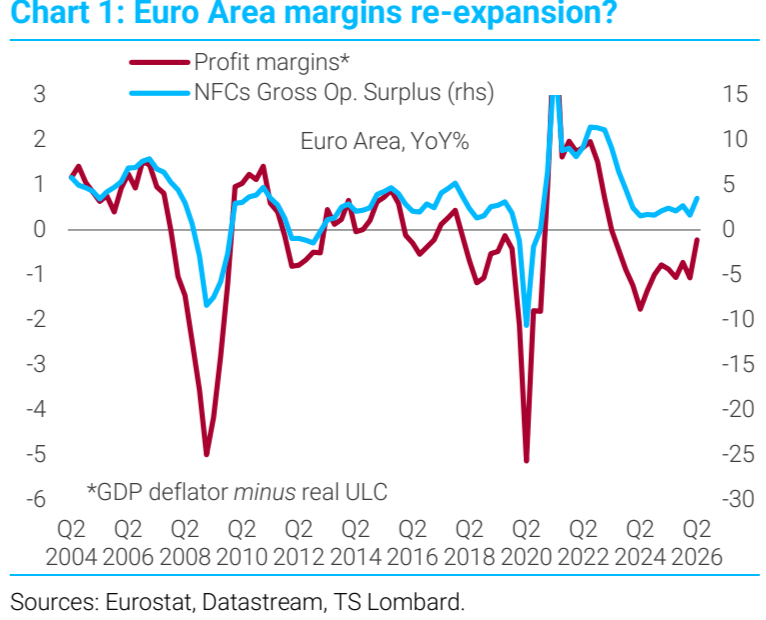
The economic recovery in Europe has been derailed twice, first by Trump's tariffs and then by the war in Iran. Even so, the setup for next year looks promising, because unlike in the U.S., European corporate profit margins are only now starting to grow.
Source: TS Lombard
Last November, European equities staged a small rally relative to U.S. equities, but at that time the war in Iran ultimately cut the rise short. Back then, the stars were already aligned relatively well: the impact of the Liberation Day tariffs was fading, the industrial cycle was showing strong signs of turning, and Germany's stimulus was also getting underway. The industrial cycle and German fiscal policy continue to support the economy, but rising energy prices and interest rates, as well as political uncertainty, have nevertheless increased savings and weighed on consumption and investment, particularly in France. I recently read an article by TS Lombard arguing, however, that most of the risks are already priced into European assets. So, once again, there could be light at the end of the tunnel.
U.S. weaknesses are Europe's strengths
TS Lombard estimates that U.S. corporate earnings have likely already peaked. The reasons include the fading returns of the energy sector, the slowdown in AI investments, and rising unit labor costs. In contrast, each of these factors has a positive mirror image for Europe.
Source: TS Lombard
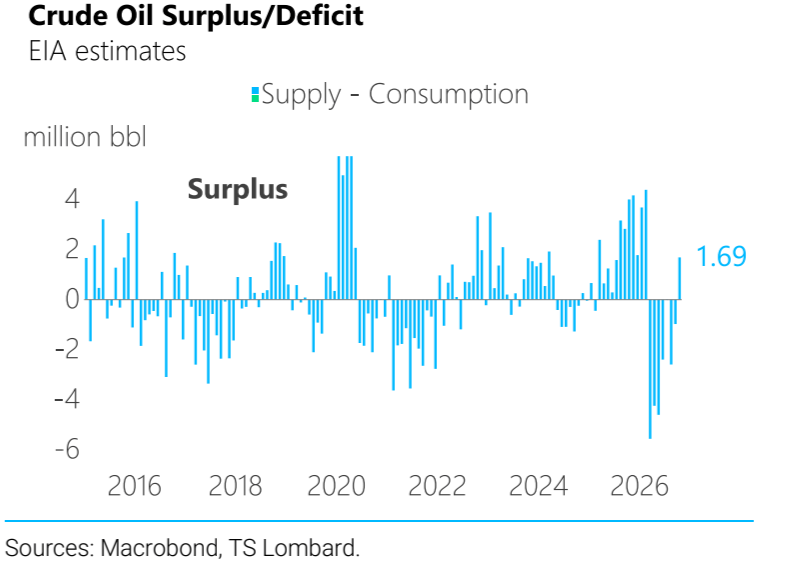
As a net importer of energy, Europe would benefit from a resolution of the conflict in Iran, and even a stabilization of the situation would help. Oil flows through the Strait of Hormuz have largely returned to pre-war levels, and for the first time since the start of the war, the oil market is in a production surplus. During the energy shock, European households increased their savings, so falling prices would free up money for consumption.
Source: TS Lombard
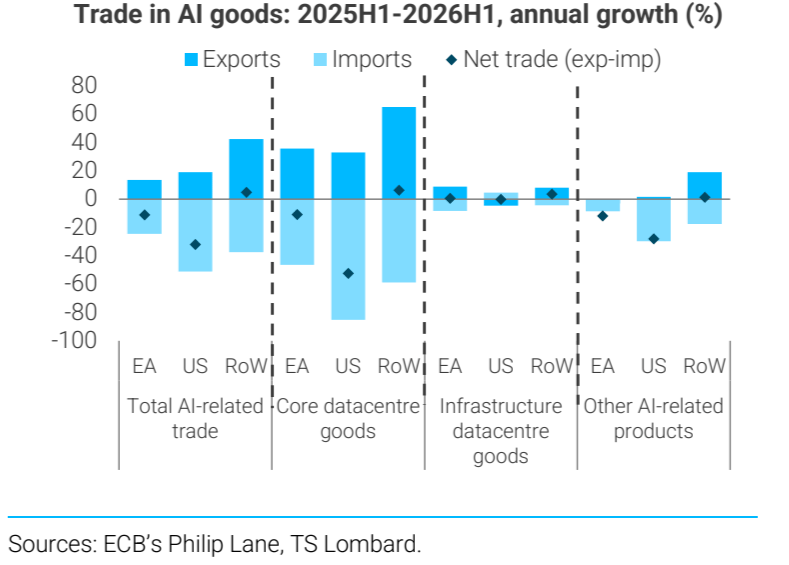
AI also matters little to the European economy and stock market, as AI accounts for only ~10% of the Stoxx 600 index, Europe's counterpart to the S&P 500. In the eurozone, AI-related imports have grown faster than exports, so the net impact on growth has been negative. Furthermore, European households do not hold as much equity wealth as U.S. households, which is the channel through which a fall in AI share prices would feed into consumption.
In addition, unit labor costs here in Europe are turning downward. European companies held on to their employees even during lean times, so the acceleration in production is now showing up as productivity growth. TS Lombard expects wages to rise by 2.5–3% next year and eurozone GDP to grow by ~1.5%, which will support margins, particularly in Germany. Improving profitability, in turn, can accelerate investment.
Three risks could derail the promising setup. The first is a new escalation of the situation in Iran before the new Congress convenes in the United States in January. The second is a harder-than-expected tightening by the Fed, and the third is that the weakness in AI stocks broadens into a selling wave affecting all sectors and regions. None of these would spare Europe's "boring" but promising stock market either.
